
The automotive photography industry faces a persistent problem: studio-quality vehicle images require expensive equipment, professional photographers, and dedicated studio space—investments that can cost $25,000 to $60,000 in setup alone, with per-car fees ranging from $30 to $50. For dealerships managing hundreds of listings, Turo hosts rotating inventory, and independent sellers, this expense becomes prohibitive. Yet inconsistent, poorly lit lot photos directly damage conversion rates and customer trust. The gap between what buyers expect to see and what dealers can afford to produce has never been wider.
Artificial intelligence is closing that gap. AI photoshoot technology automatically transforms ordinary vehicle photographs into studio-quality assets by removing backgrounds and replacing them with professional settings—showroom interiors, pristine white studios, urban landscapes, or natural environments—in seconds. This shifts automotive photography from a capital-intensive service to an automated, scalable process that costs pennies per image instead of dollars.
Quick Answer: AI photoshoot technology uses machine learning to remove vehicle backgrounds and replace them with professional studio backdrops, instantly transforming lot photos into gallery-ready listings. For car businesses, this eliminates expensive photographer fees and studio rental costs while maintaining consistency across hundreds of images—critical for competitive online presence and higher click-through rates on listings.
This guide explores how AI-powered automotive photography works, why dealerships and auto sellers are adopting it at scale, and how to implement it strategically to maximize your inventory presentation. You'll discover the mechanics behind background removal, learn which approach fits your operation, and understand when automated photography outperforms traditional methods. Whether you're managing a dealership lot, hosting vehicles on Turo, or selling privately, the economics and quality standards have fundamentally shifted—and understanding that shift is essential to staying competitive.
Table of Contents
- How AI Photoshoot Technology Works: The Complete Process
- Real-World Results: AI Photoshoot Performance Across Vehicle Types
- Cost Comparison: AI Photoshoot vs. Traditional Photography Methods
- Pricing Breakdown by Method
- ROI Across Business Sizes
- Who Benefits Most from AI Photoshoot: Use Cases and Business Applications
- Key Features to Evaluate When Choosing an AI Photoshoot Platform
- Making the Transition to AI Photoshoot in 2026: Next Steps for Your Business
How AI Photoshoot Technology Works: The Complete Process
The workflow behind AI-powered automotive photography is deceptively simple on the surface, yet sophisticated in execution. The process unfolds in four distinct stages: image capture and upload, intelligent background detection, automated removal and replacement, and final export—each optimized for speed without sacrificing quality.
Image Upload and Analysis
When you upload a car photo to an AI photoshoot system, the platform immediately analyzes the image using deep learning models trained on thousands of vehicle photographs. These models identify the vehicle's boundaries, edges, and spatial relationship to the background within seconds. The system doesn't just look for color differences; it understands vehicle geometry, reflections, and complex shapes like wheels, mirrors, and trim details. This semantic understanding is what separates effective AI background removal from crude, amateur results that leave halos or cut into the vehicle itself.
Background Detection and Removal
The removal phase leverages convolutional neural networks to segment the vehicle from its surroundings with pixel-level precision. Rather than using simple color-matching tools, modern systems recognize that cars exist in three-dimensional space and apply sophisticated masking algorithms that preserve fine details—chrome reflections, window transparency, shadow nuances. According to research on AI image processing timelines, most professional platforms complete this step in 10-30 seconds per image, making batch processing of entire inventory feasible within hours rather than days.
Background Selection and Replacement
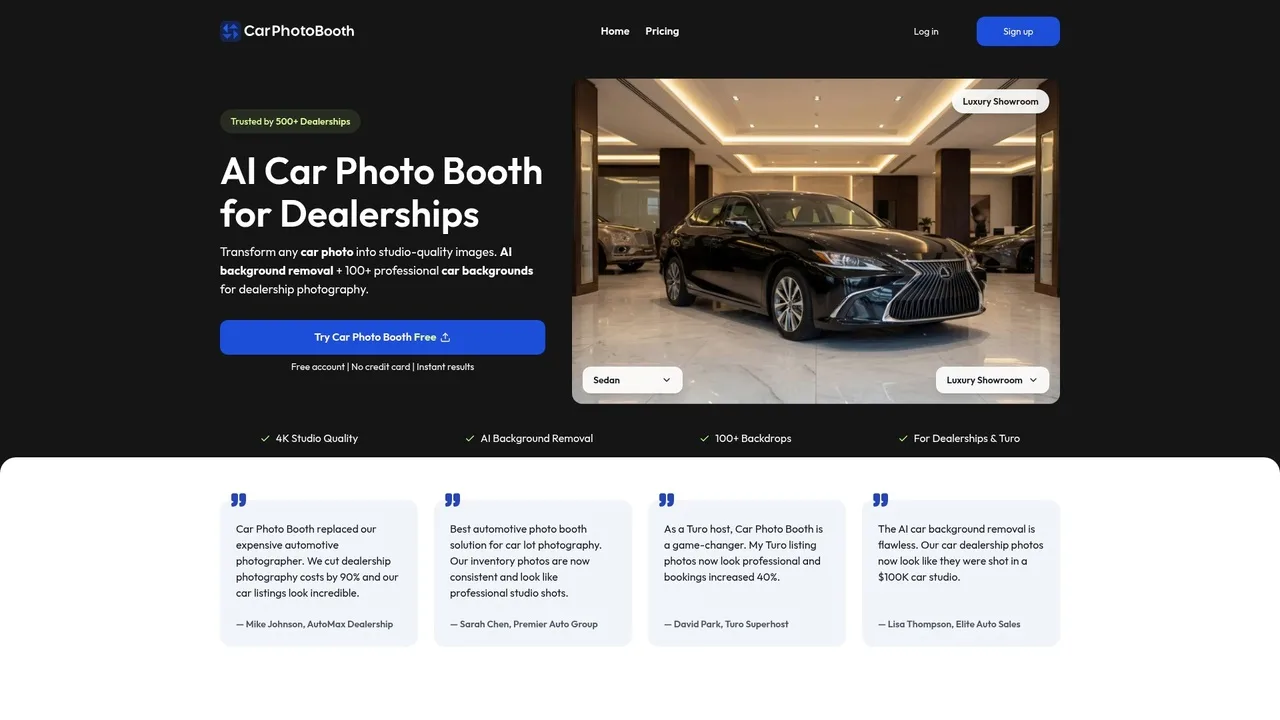
Once isolated, the vehicle is composited onto your chosen backdrop. Car Photo Booth offers over 100 professionally designed environments—showroom interiors, pristine white studios, urban streets, natural landscapes—each calibrated for lighting consistency and shadow realism. The AI automatically adjusts vehicle shadows and reflections to match the new background, ensuring the final image looks photographed in-studio rather than digitally pasted together.
Export and Quality Standards
The finished image exports in 4K resolution, ready for dealership listings, Turo inventory, or marketing materials. The entire pipeline—from upload to download—typically completes in under one minute, enabling dealerships to process hundreds of vehicles in a single session. This speed, combined with consistency across all images, directly addresses the fragmented quality problem that plagues lot photography.
Real-World Results: AI Photoshoot Performance Across Vehicle Types
The transformation from lot photography to studio-quality imagery becomes tangible when examining how different vehicle categories respond to AI background replacement. Sedans benefit dramatically from showroom backdrops—the clean lines of the vehicle stand out against neutral or luxury showroom environments, emphasizing proportions and design details. Luxury vehicles, in particular, gain credibility when composited onto high-end showroom settings or urban landscapes; the professional context elevates perceived value without requiring a physical studio setup.
Trucks and SUVs present distinct advantages when placed against outdoor or industrial backgrounds. These vehicles photograph authentically against natural landscapes or urban streets, where their scale and ruggedness resonate with buyer expectations. Specialty vehicles—sports cars, vintage models, classic restorations—achieve their highest visual impact against curated backdrops that complement their aesthetic: sleek urban environments for performance cars, scenic routes for convertibles, or minimalist white studios for rare collectibles.
| Vehicle Type | Optimal Background | Key Benefit |
|---|---|---|
| Sedans | Showroom / White Studio | Emphasizes design, professional context |
| Luxury Vehicles | High-end Showroom / Urban | Reinforces prestige, aspirational appeal |
| Trucks & SUVs | Natural Landscape / Industrial | Highlights capability, authentic positioning |
| Sports Cars | Urban Street / Minimalist | Conveys performance, modern aesthetic |
Consistency across your entire inventory—whether processing 50 vehicles or 500—ensures cohesive visual branding across listings. According to research from Dealer.com, listings featuring real, professional-quality photos are 30–40% more likely to generate leads. When every vehicle in your catalog maintains uniform lighting, shadow treatment, and background quality, viewers perceive your dealership or rental fleet as organized and trustworthy. This uniformity, achieved in minutes rather than weeks of coordinated studio sessions, directly addresses the fragmented appearance that undermines lot photography.
Cost Comparison: AI Photoshoot vs. Traditional Photography Methods
The economics of automotive photography shift dramatically when you move from traditional methods to AI-powered solutions. Understanding the true cost structure—not just per-vehicle pricing, but total cost of ownership across different business scales—reveals why dealerships and rental operators are making the switch.
Pricing Breakdown by Method
Professional photographers typically charge according to DealerRefresh industry forums, with rates ranging from $15–20 per vehicle for service providers, though independent photographers often command $50–300 per hour depending on experience. Beyond the shoot itself, post-production editing—background removal and replacement—adds another $5–15 per vehicle. Physical photo booths demand substantial upfront capital: according to industry pricing, booth-only setups start at $38,000, with financing options around $893 monthly. Studio rental compounds costs further, typically running $100–300 per hour plus equipment fees.
Car Photo Booth eliminates these layers. At $3–7 per vehicle depending on volume, the cost structure becomes dramatically more predictable and scalable.
| Method | Per-Vehicle Cost | Setup Cost | Monthly Overhead | Best For |
|---|---|---|---|---|
| Professional Photographer | $20–50 | $0 | $0 (variable) | Small lots, specialty vehicles |
| Photo Booth Installation | $15–25 | $38,000–43,000 | $893+ | High-volume dealerships only |
| Studio Rental | $30–80 | $0 | $500–2,000 | Occasional, premium shoots |
| AI Photoshoot (Car Photo Booth) | $3–7 | $0 | $7–200 | All scales, consistent quality |
ROI Across Business Sizes
For a 10-vehicle-per-month operation, hiring photographers costs $200–500 monthly. Car Photo Booth costs roughly $70 at the starter tier, delivering 80% cost savings immediately. At 50 vehicles monthly, professional photography reaches $1,000–2,500; AI solutions scale to $150–350, freeing capital for inventory acquisition or marketing. For dealerships processing 200+ vehicles monthly, the gap widens further. Professional services demand $4,000–12,500 monthly; AI-powered processing costs $600–1,400—a difference of $3,400–11,100 that compounds annually into six figures.
The affordability advantage extends beyond direct pricing. AI solutions eliminate scheduling delays, location constraints, and quality inconsistency that plague lot photography. When you can process inventory in-house within seconds, you reduce time-to-listing and maintain visual uniformity across your entire catalog—factors that according to Redline Automotive Merchandising, can increase lead volume by up to 40% on both new and used vehicles.
Scalability becomes the decisive factor. Traditional methods hit capacity ceilings; AI solutions scale infinitely without proportional cost increases, making them the only cost-effective option for high-volume operations.
Who Benefits Most from AI Photoshoot: Use Cases and Business Applications
Dealership Photo Departments face the most acute pain point: maintaining visual consistency across hundreds of vehicles while managing tight timelines. A typical used-car lot receives 15–30 new inventory units daily, each requiring multiple angles and backgrounds for online listings. Professional photographers demand $30–50 per vehicle; physical photo booths require $25,000–60,000 in upfront capital plus ongoing maintenance. Dealership photo departments using AI solutions compress their workflow from hours to minutes, processing entire daily inventory in-house without scheduling conflicts or location constraints. The result is uniform, professional imagery across every listing—a critical factor in dealership photo workflow optimization that directly improves search rankings and click-through rates.
Turo Rental Hosts operate under different constraints: they need professional listings fast, with minimal investment. A host launching 20 new vehicles faces a choice between hiring a photographer ($600–1,000 for the shoot) or accepting amateur lot photos that underperform. According to Turo's own research, listings displaying verified professional photos receive 30% more booking requests on average. AI photoshoot technology eliminates this friction—hosts photograph their vehicles with smartphones, then transform those images into studio-quality assets within seconds, dramatically improving competitiveness without the cost barrier.
Independent Car Photographers and Fleet Management Companies encounter scalability bottlenecks. Photographers handling 50+ vehicles monthly hit capacity ceilings that prevent growth; fleet operators managing corporate or rental inventories struggle with inconsistent imagery across locations. AI-powered automotive photography solutions allow photographers to expand service capacity without hiring additional staff, while fleet managers maintain brand consistency across distributed operations.
Automotive Marketplaces and Online Retailers benefit from standardized, high-volume processing. When you're listing 500+ vehicles monthly across multiple platforms, manual retouching becomes impossible. AI background replacement delivers uniform quality at scale—every vehicle receives the same professional treatment regardless of original lot conditions.
The common thread across all personas: they need rapid, cost-effective, consistent results. Traditional methods optimize for one variable; AI photoshoot technology optimizes for all three simultaneously, making it the only scalable solution for high-volume automotive operations.
Key Features to Evaluate When Choosing an AI Photoshoot Platform
Selecting the right AI-powered automotive photography platform requires moving beyond marketing claims to assess concrete capabilities that directly impact your workflow and output quality. The distinction between a capable solution and a mediocre one often comes down to features that seem minor on paper but compound into significant operational differences.
Background Variety and Customization form the foundation of professional results. A platform should offer at least 50+ professionally designed backgrounds spanning showroom environments, outdoor settings, urban backdrops, and neutral studios. More importantly, evaluate whether you can customize colors, lighting, and composition to match your brand identity. Some platforms provide static backgrounds only; others allow subtle adjustments that ensure consistency across your entire catalog. Ask vendors: Can you modify backgrounds to match your dealership's branding? Are seasonal or themed backgrounds available?
Processing Speed and Batch Capabilities directly affect scalability. A single-image processing time under 15 seconds is acceptable; under 10 seconds is competitive. However, batch upload functionality matters more for high-volume operations. Can the platform process 50 images simultaneously, or must you upload them one at a time? Batch processing transforms a tedious manual task into a streamlined operation—critical for dealerships managing 100+ vehicles monthly.
Integration with Listing Platforms determines whether you can automate your entire workflow. Native integrations with AutoTrader, Craigslist, Facebook Marketplace, and your dealership management system (DMS) eliminate manual re-uploading. API availability enables custom integrations if your tech stack requires it. Request a technical specification sheet detailing supported platforms and integration methods.
Image Quality Consistency across vehicle types, lighting conditions, and angles reveals the platform's underlying technology robustness. Request sample outputs for sedans, SUVs, trucks, and luxury vehicles photographed in poor lot lighting. Inconsistent results suggest the AI struggles with edge cases—a problem that will surface when you process your most challenging inventory.
Pricing Transparency and Scalability matter as your volume grows. Understand whether pricing is per-image, monthly subscription, or tiered by volume. Calculate your true cost-per-vehicle across your expected monthly volume, then project costs at 2x and 3x growth. The cheapest platform today may become prohibitively expensive at scale.
Customer Support Quality becomes critical when processing fails or results disappoint. Evaluate response times, technical expertise, and whether support staff understand automotive photography requirements—not just generic image processing tools.
Making the Transition to AI Photoshoot in 2026: Next Steps for Your Business
The shift from traditional automotive photography to AI-powered solutions represents a fundamental change in how dealerships, rental platforms, and independent sellers create inventory images. The economics are compelling: AI photoshoot technology eliminates the need for expensive studio setups or recurring photographer fees, compressing what once took hours into seconds. More importantly, it standardizes visual quality across your entire catalog—a consistency that manual photography struggles to maintain.
Starting your transition requires a methodical approach. Begin with a free trial on a platform like Car Photo Booth to process 15–20 vehicles from your current inventory. Compare the AI-transformed images directly against your existing lot photos and professional shots. Evaluate not just the background replacement, but edge detection around wheels, trim, and reflections—areas where inferior AI often falters. Calculate your true cost-per-vehicle at your expected monthly volume, accounting for subscription tiers as your usage scales.
Next, identify your highest-impact use case: perhaps refreshing slow-moving inventory or standardizing Turo listings. Process a sample batch, share results with your team, and measure the impact on click-through rates or inquiry volume. Document the time saved—this becomes your ROI baseline.
The future of automotive photography is hybrid: AI handles the repetitive work of background removal and consistency, freeing professional photographers to focus on creative angles, lighting refinement, and edge cases. By adopting this technology now, you're not replacing expertise—you're amplifying it. The question isn't whether to transition, but how quickly you can implement it to outpace competitors still managing hundreds of photos manually.