
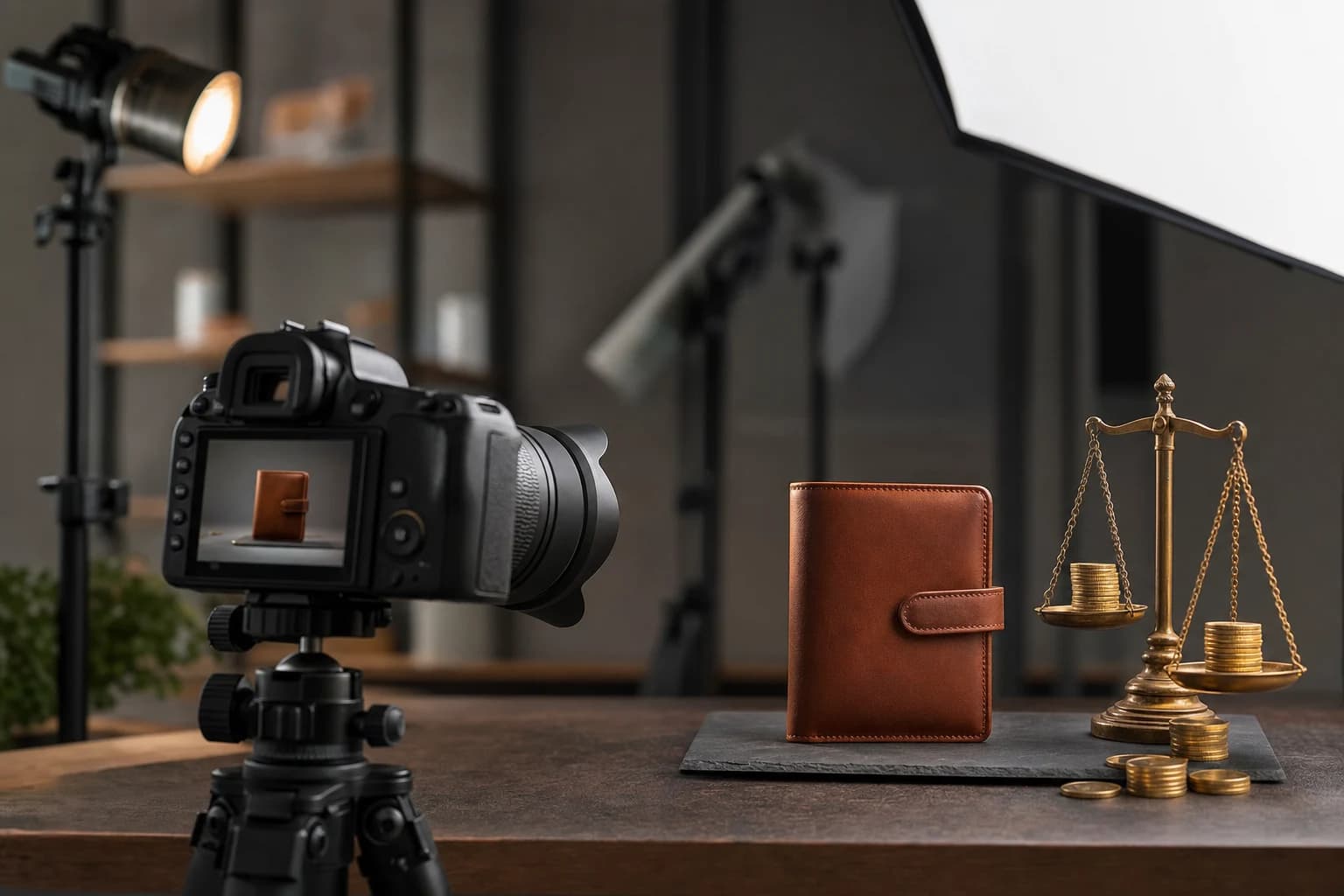
Professional automotive photography doesn't have to drain your budget. For dealerships, rental hosts, and automotive resellers, understanding the true costs of quality car imagery is essential to making informed decisions about presenting inventory online.
Quick Answer: Professional product photography for vehicles typically ranges from $300–$2,000+ per car, depending on location, photographer experience, and studio setup. Costs vary dramatically because traditional shoots require expensive equipment and labor—but AI-driven solutions now deliver studio-quality results without the premium price tag.
In this guide, we'll break down what you're paying for when hiring a photographer, explore the pricing factors that influence automotive photography rates, and reveal modern strategies—including AI image enhancement—that maintain professional standards while controlling costs. Whether you're running high-volume operations or launching your first online listings, you'll discover realistic benchmarks and proven methods to optimize your photography budget without sacrificing quality.
Table of Contents
- Understanding Product Photography Pricing in the Auto Sector
- Common Pricing Models for Car Photography Services
- What Drives Product Photography Costs
- AI-Powered Photography Solutions vs. Traditional Studio Pricing
- Choosing the Right Car Photography Solution for Your Budget
- Frequently Asked Questions About Car Product Photography Pricing
- Final Thoughts on Budgeting for Car Product Photography in 2026
Understanding Product Photography Pricing in the Auto Sector
For automotive dealers, Turo hosts, and car resellers, the question of how much to invest in vehicle photography isn't merely about aesthetics—it's fundamentally about revenue and competitive advantage. According to CDK Global's research on dealership photography, nearly 90% of car shoppers are initially drawn to a dealership's website based on photo quality, and 90% eliminate vehicle options based on images alone. This underscores why product photography pricing deserves careful strategic attention.
The business case is straightforward: listings with professional automotive photography sell significantly faster than amateur shots. High-quality imagery commands higher prices and accelerates inventory turnover—critical when every unmerchandised vehicle costs dealers up to $50 daily. For operations managing dozens or hundreds of cars, the compounding cost of slower velocity becomes substantial.
Cheap photography often backfires. Inconsistent backgrounds, poor lighting, and amateur composition erode buyer confidence and reduce conversion rates. The lowest-priced photographer may deliver acceptable results occasionally, but inconsistency across your full inventory damages brand perception and influences purchase behavior.
Understanding automotive photography rates means recognizing that pricing reflects professional-grade equipment, studio or location costs, and post-processing expertise. The decision between traditional studio photography and modern AI-enhanced alternatives should weigh both upfront cost and total cost of ownership across your entire inventory volume. Strategic investment in quality imagery pays dividends through faster sales, higher margins, and stronger customer trust—returns that far exceed the initial expenditure.
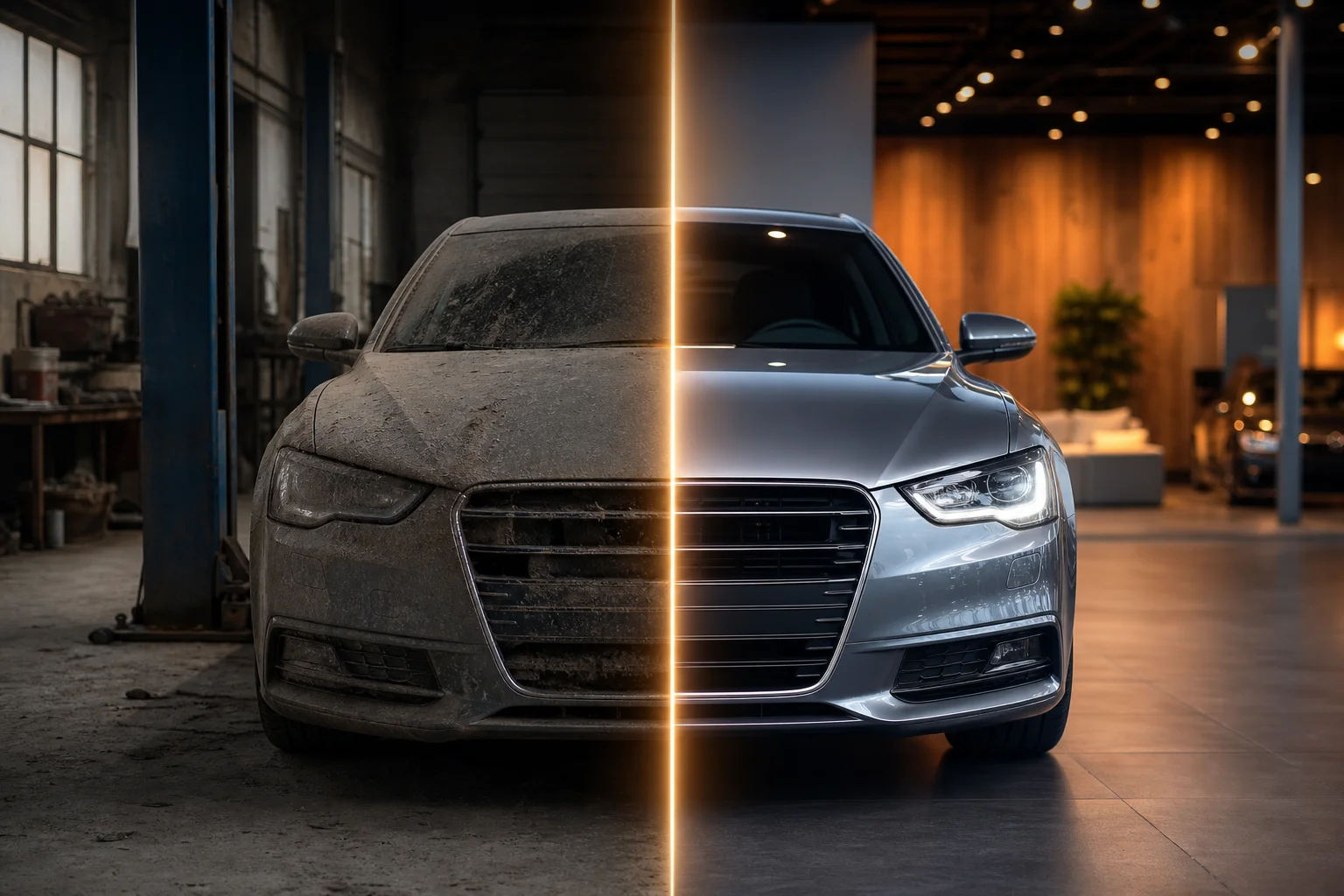
The visual difference between amateur and professional photography directly impacts buyer perception.
Common Pricing Models for Car Photography Services
Automotive photographers employ distinct pricing structures, each suited to different dealer operations and inventory volumes. Understanding these models helps you forecast costs accurately and negotiate terms that align with your business cycle. The choice between pricing approaches significantly impacts your per-unit cost and service consistency.
Per-Image Pricing for Individual Vehicle Shots
Per-image pricing remains the most straightforward model for dealers testing photography services or managing small inventories. According to DealerRefresh Automotive Dealer Forums, per-vehicle pricing for dealership photography typically ranges from $15–$20 per vehicle as the national average, with rates varying from $5–$50+ depending on service level and editing complexity.
This model works well for single-vehicle shoots or small batches (5–15 cars). However, scaling becomes expensive. A 50-car inventory at $25 per image totals $1,250—costs that compress dramatically at higher volumes using alternative models.
Hourly and Day Rates for Large-Scale Shoots
Professional automotive photographers charge between $50 to $300 per hour, with experienced product specialists commanding $150–$500 per hour in 2026, according to FrameOnce. Day rates for automotive photography typically run $1,500–$10,000 depending on experience and shoot complexity, with half-day rates usually 60–70% of the full day rate.
Day rates favor high-volume shoots. Photographing 30–50 vehicles in a single day often reduces per-vehicle cost below $30, especially when negotiating recurring bookings. Dealers with weekly or monthly photography needs can establish preferred-vendor relationships that lower effective rates over time.
Package Deals and Retainer Contracts
Bundled pricing and retainer agreements offer the lowest per-image costs and most predictable budgets. Dealers committing to 20–100 vehicles monthly typically negotiate tiered packages where cost-per-image drops 40–60% versus one-off bookings. Monthly retainers also ensure scheduling consistency and brand uniformity across your catalog.
For dealers unwilling to commit to recurring studio shoots, AI-enhanced photography solutions like Car Photo Booth provide per-image costs under $10 while maintaining studio-quality consistency across your entire inventory without session fees or location overhead.
What Drives Product Photography Costs
Professional automotive photography expenses stem from five interconnected elements: equipment investment, post-production labor, studio or location rental, photographer expertise, and turnaround time. Understanding where your budget actually goes demystifies why quality vehicle imagery commands premium pricing.
Professional Equipment and Technical Setup
High-end automotive photography demands substantial capital investment in cameras, lenses, and lighting systems. Professional DSLR and mirrorless cameras range $3,000–$6,500 each; automotive-grade lenses (wide-angle, telephoto, macro) add another $8,000–$15,000 per kit. Studio-quality lighting rigs—essential for consistent, shadow-controlled vehicle imagery—cost $5,000–$25,000 depending on sophistication. Photographers factor these equipment costs into daily rates, plus studio rental ($500–$2,000 per shoot day), props, and backdrops. You're not just paying for their time; you're funding their capital infrastructure.
Post-Production and Editing Labor
According to Nightjar's analysis of product photography costs, post-production labor typically represents 20–50% of total shoot expenses. For automotive images, this includes background removal, color correction, shadow adjustment, and retouching—labor-intensive tasks consuming 15–45 minutes per image. A 30-vehicle shoot can demand 30–45 additional editing hours. This explains why studios charge per-image editing fees ($15–$50 each) alongside shooting fees.
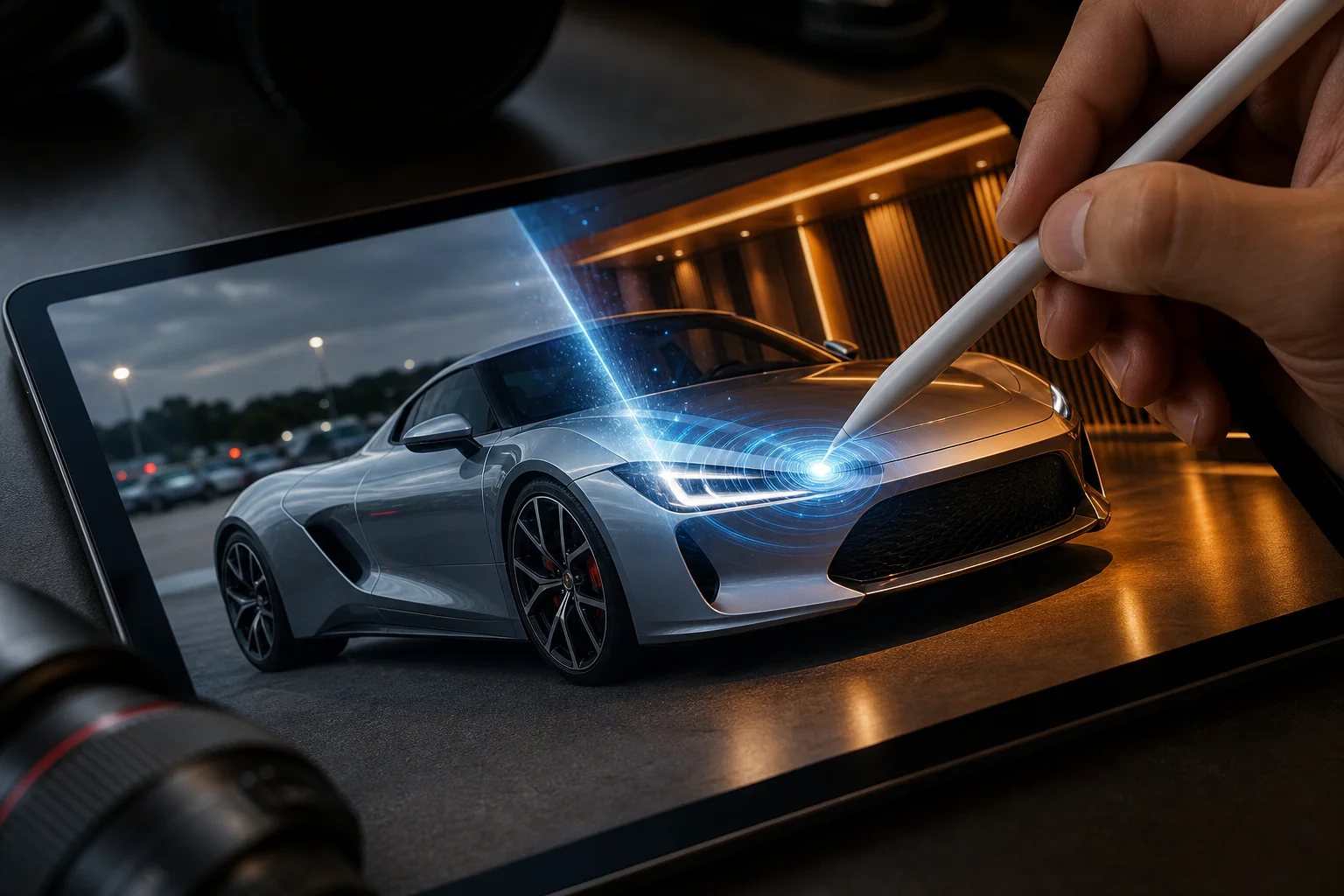
Post-production is a critical, labor-intensive phase of automotive photography.
Photographer Experience and Turnaround Time
Veteran automotive photographers with proven portfolios and established clientele command $1,500–$10,000 day rates versus $300–$800 for emerging talent. Their premium reflects faster workflows, superior problem-solving, and consistent output quality. Expedited turnaround (24–48 hours versus standard 5–7 days) typically adds 25–40% to final cost. Skill translates directly to efficiency—experienced shooters capture usable frames faster, requiring less post-production correction.
These cost components justify professional pricing, yet they also explain why AI-enhanced alternatives like Car Photo Booth appeal to dealers seeking studio-quality consistency without production overhead.
AI-Powered Photography Solutions vs. Traditional Studio Pricing
The emergence of AI-driven background removal and virtual studio technology has fundamentally altered cost calculations for high-volume automotive inventory. Where traditional photographers command premium rates for post-production labor, intelligent automation compresses editing timelines from hours to seconds while maintaining professional output quality.
Traditional Photography Costs vs. AI-Enhanced Solutions
Traditional product photography pricing for automobiles hinges on shooting fees, editing labor, and turnaround premiums. A typical dealership pays $150–$400 per vehicle for basic studio shoots, plus $15–$50 per-image editing—costs that multiply rapidly across 50+ vehicle inventories. According to research from Spyne AI, AI-powered background replacement and virtual studio solutions can reduce photography costs by up to 75% while processing images in just 2–5 seconds per photo.
The comparison below illustrates the financial divergence:
| Metric | Traditional Studio | AI-Enhanced Solution |
|---|---|---|
| Per-Vehicle Cost | $200–$600 | $15–$50 |
| Editing Time per Image | 15–45 minutes | 2–5 seconds |
| 50-Vehicle Batch Time | 5–7 days | 4–10 minutes |
| Turnaround Add-On | +25–40% | 0% (standard speed) |
| Background Customization | Limited | 100+ professional templates |
Efficiency Gains: Turnaround Time and Scaling
For dealers managing high-volume inventory, speed translates directly to competitive advantage. AI solutions eliminate the editing bottleneck entirely—a photographer captures raw images on-site, uploads them, and receives studio-quality results within minutes rather than days. This acceleration proves invaluable during seasonal promotions, auction inventory refreshes, or Turo host rotations where listing speed determines rental booking rates.
Scaling becomes economically viable with AI tools. A dealership photographing 100 vehicles weekly faces prohibitive costs hiring dedicated post-production staff or paying per-image editing fees ($1,500–$5,000 monthly). With AI background removal and virtual studio alternatives like Car Photo Booth, the same volume processes automatically, reducing marginal costs per vehicle to near-zero after initial subscription investment.
The hybrid approach—professional photography paired with AI enhancement—also appeals to dealers seeking consistency without sacrificing creative control. Photographers focus on composition, lighting, and angle excellence, while AI handles repetitive background removal and color standardization. This partnership preserves professional image quality while eliminating the labor expense that historically inflated vehicle photography budgets.
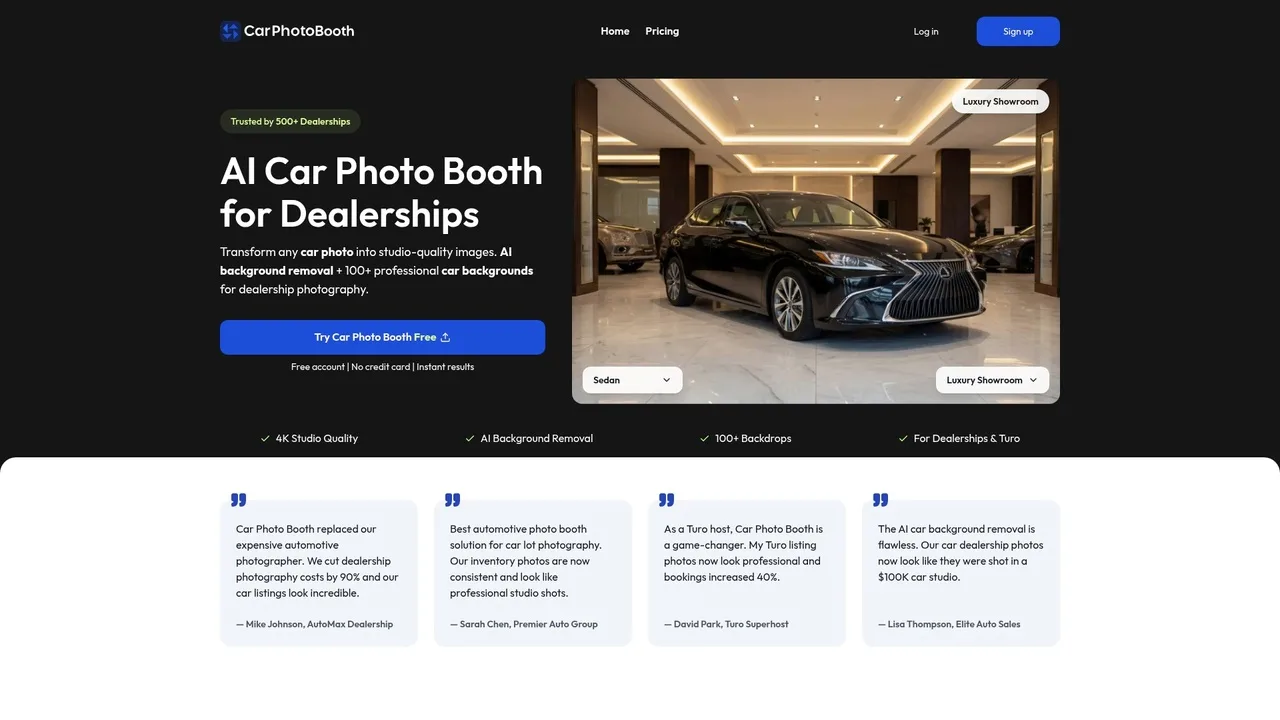
AI tools like Car Photo Booth automate background replacement to save time and money.
Choosing the Right Car Photography Solution for Your Budget
Selecting an appropriate photography approach depends on three critical variables: your inventory volume, timeline expectations, and budget constraints. Rather than defaulting to the most expensive option, map your actual needs first, then align them with cost-effective solutions.
Assessing Your Photography Needs
Answer these questions before comparing photographers or tools:
- Inventory size: How many vehicles monthly require photos?
- Quality baseline: Do you need showroom-grade images or acceptable online-listing quality?
- Turnaround requirement: Can you wait 3–5 days for edited images, or do you need same-day results?
- Annual budget: What total investment aligns with your revenue goals?
Dealers managing fewer than 10 vehicles monthly find freelance photographers or DIY approaches with AI-powered background removal sufficient. Those managing 50+ vehicles benefit from package deals, monthly retainers, or subscription-based solutions like Car Photo Booth that process unlimited images at flat monthly costs.
Calculating ROI from Quality Car Photos
Professional images drive measurable business impact. According to Dealer Specialties research, quality photography increases online-to-showroom conversion rates by 30–50% and vehicles with professional photos often sell for 5–10% more. Additionally, faster time-to-market reduces days-to-sale by 10–20%, directly lowering carrying costs.
Calculate your ROI by comparing photography investment against incremental revenue gains. If upgrading imagery increases sales by just two additional vehicles monthly, the investment typically pays for itself. For Turo hosts, faster listing turnover directly translates to higher booking rates during peak seasons—making photography speed and consistency crucial competitive advantages.
Investing in quality photography drives measurable ROI through faster sales.
The decision framework is straightforward: smaller inventories pair well with freelancers or AI enhancement tools; mid-to-large operations justify hybrid approaches or platform investments that eliminate editing bottlenecks entirely.
Frequently Asked Questions About Car Product Photography Pricing
What's a fair price per car photo?
Pricing typically ranges from $25–$150 per image for freelance photographers, depending on usage rights and retouching depth. Studio photography costs $75–$300+ per vehicle. For high-volume operations, subscription models and AI-powered enhancement solutions like Car Photo Booth reduce per-image cost to mere dollars monthly, making photography costs nearly negligible when spread across hundreds of listings.
How many photos does a car need?
Most online listings perform best with 8–12 images: multiple exterior angles, interior shots, detail close-ups, and a full exterior view. Professional backgrounds improve listing appeal and conversion rates without requiring additional shoots.
Why do prices vary so much?
Variation stems from equipment investment, turnaround time, post-production labor, and licensing terms. Rush orders, complex retouching, and commercial usage rights increase costs substantially.
Can I DIY car photos affordably?
Smartphone photography paired with AI background removal produces acceptable results at minimal cost. However, consistency suffers, and manual editing remains time-intensive across larger inventories.
What's the cheapest way to get professional-looking photos?
AI-powered enhancement platforms process unlimited images at flat monthly rates, eliminating per-photo charges. This approach combines affordability with scalability, especially for dealers managing high inventory turnover and needing rapid catalog updates.
Final Thoughts on Budgeting for Car Product Photography in 2026
The cost of car product photography hinges on three interconnected factors: your inventory volume, operational workflow, and long-term business goals. Pricing models range from per-image charges ($25–$150) to subscription-based platforms, each suited to different dealer scales. The emergence of AI-powered enhancement tools has fundamentally reshaped this equation, eliminating the traditional trade-off between affordability and consistency.
However, selecting the cheapest option frequently undermines return on investment. Professional-quality vehicle imagery drives conversion rates, reduces inquiry friction, and shortens sales cycles—making photography investment a revenue lever, not a cost center. Evaluate your inventory turnover, compare upfront costs against potential revenue impact, and choose solutions that scale with your business rather than constrain it. Your decision today determines whether photography becomes a competitive advantage or a monthly drain.