
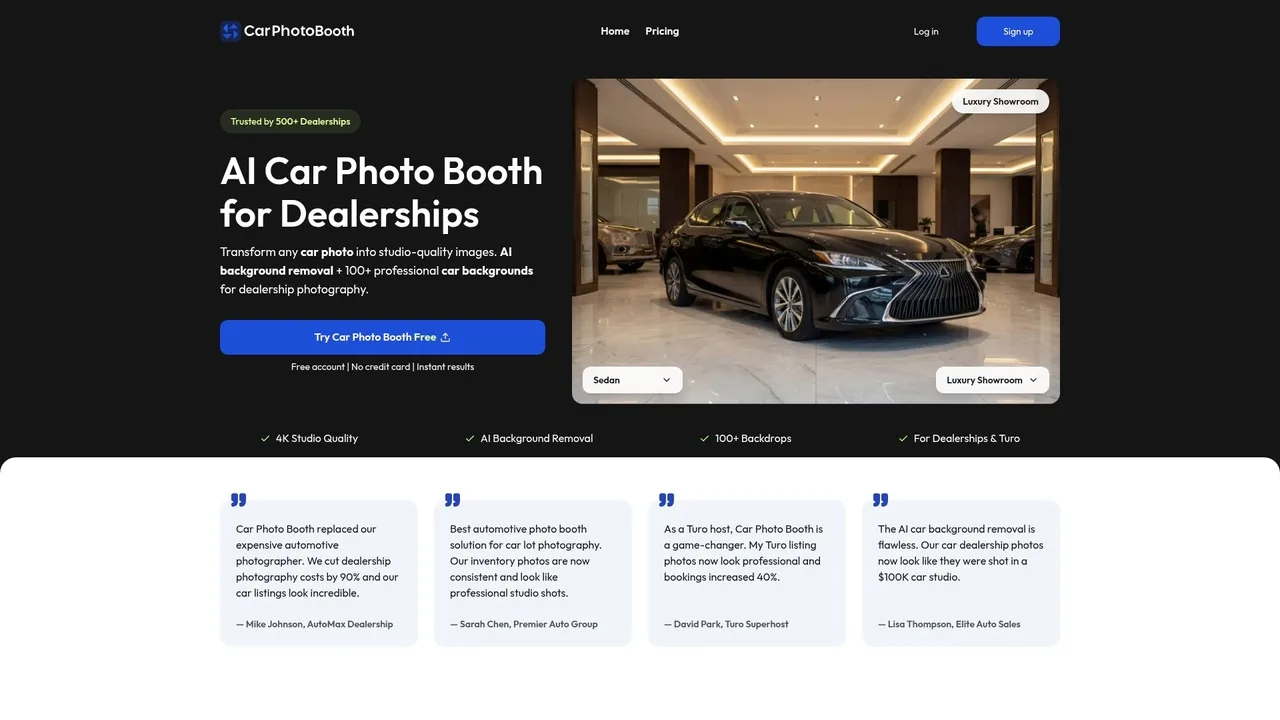
An AI photoshoot represents a fundamental shift in how dealerships and auto sellers approach vehicle photography. Rather than scheduling expensive studio sessions or relying on inconsistent lot photos, this technology uses artificial intelligence to instantly transform ordinary car images into polished, studio-quality assets. The process is straightforward: upload a photo, remove the background, select from over 100 professional backdrops—showroom, white studio, urban, nature—and export a production-ready image in seconds.
Quick Answer:
AI photoshoots for vehicles use machine learning to automatically remove backgrounds from car photos and replace them with professional studio settings, delivering gallery-quality results in seconds rather than hours. This eliminates the need for expensive photography sessions, equipment rentals, or inconsistent lot photos. For dealerships, Turo hosts, and auto photographers, this means faster inventory processing, lower per-image costs, and uniform visual presentation across listings.
This article explores what makes AI photography different from traditional methods, how the technology works in practice, the specific advantages for automotive businesses, real implementation workflows, and when AI solutions make financial sense compared to conventional shooting. We'll also address the limitations and help you determine whether this approach fits your operation's needs and budget.
Table of Contents
- Why Traditional Car Photography Costs So Much (And How AI Changes That)
- How AI Photoshoot Technology Works for Automotive Imagery
- Key Benefits of AI Photoshoots for Dealerships and Auto Sellers
- Real-World Use Cases: Who Benefits Most from AI Photoshoots
- Getting Started with AI Photoshoots: A Simple 3-Step Process
- Transform Your Car Inventory with AI Photoshoots in 2026
Why Traditional Car Photography Costs So Much (And How AI Changes That)
The economics of traditional dealership photography solutions reveal why so many dealers are frustrated with their current workflows. Setting up a professional automotive studio photography operation requires substantial upfront capital. Overhead lighting systems, backdrop infrastructure, and controlled environments can easily exceed $25,000 to $60,000 in initial setup costs alone. For smaller dealerships or independent Turo hosts, this barrier is prohibitive—it locks quality photography behind a paywall accessible only to larger operations.
Beyond infrastructure, the per-vehicle labor costs compound quickly. According to industry pricing data, dealerships typically pay between $10 to $30 per vehicle for photography services, with luxury dealerships paying $30 to $50 per car for premium work. Professional automotive photographers themselves charge $50 to $300 per hour depending on experience level, meaning a single shoot day can consume significant budget with minimal output. Add post-processing time—background removal, color correction, and environment replacement—and you're looking at an additional $5 to $15 per vehicle just for editing.
The hidden friction extends beyond dollars. Traditional photography introduces inconsistency: lot photos vary wildly in lighting, angle, and background clutter. A vehicle shot on an overcast Tuesday looks dramatically different from one photographed in golden hour, creating a disjointed catalog that undermines brand perception. Processing delays mean inventory sits in limbo for days while photographers schedule sessions and editors work through backlogs. For dealers managing hundreds of vehicles monthly, this timeline friction directly impacts sales velocity.
This is where the economics shift fundamentally. AI-powered car photography tools eliminate the studio overhead entirely—no equipment rental, no facility costs, no hourly photographer fees. The technology automatically removes backgrounds and applies professional studio environments in seconds, reducing costs by up to 75% compared to traditional methods. Consistency becomes automatic: every vehicle receives identical lighting treatment and professional presentation, regardless of when or where the original photo was taken. Processing time collapses from days to seconds, keeping inventory fresh and responsive to market demand.
How AI Photoshoot Technology Works for Automotive Imagery
The process behind AI-powered automotive image processing is deceptively simple on the surface, yet sophisticated in execution. When you upload a car photo—whether shot on a dealership lot, in natural light, or against a cluttered background—the system's neural network analyzes the image in milliseconds to identify and isolate the vehicle from its surroundings. This isn't crude cropping; the AI recognizes vehicle contours, reflections, shadows, and fine details like chrome trim and window reflections, preserving every nuance while cleanly separating the car from the background.
Once isolation is complete, the second phase begins: background replacement. Rather than applying a generic white box or flat color, the technology overlays one of 100+ professionally designed environments—showroom floors with studio lighting, outdoor urban settings, luxury resort backdrops, or minimalist white studios. Each backdrop is engineered with proper perspective, lighting angles, and shadow placement so the vehicle integrates seamlessly, as if it were photographed in that exact location. The AI adjusts vehicle lighting and shadow depth to match the chosen environment, eliminating the telltale signs of digital compositing that plague amateur edits.
The entire transformation occurs in under 10 seconds. A dealer can upload 50 lot photos in the morning and have studio-quality images ready for listing by afternoon—no scheduling photographers, no waiting for editing queues, no inconsistent results. When you need to change car photo backgrounds at scale, this speed becomes a competitive advantage. The output renders at 4K resolution, suitable for high-resolution displays and print materials, ensuring your inventory looks equally polished across every sales channel.
Key Benefits of AI Photoshoots for Dealerships and Auto Sellers
The financial impact of switching to AI-powered automotive inventory management is immediate and measurable. Traditional dealership photography costs between $30–50 per vehicle when hiring professional photographers or operating physical photo booths that require $25,000–$60,000 in upfront equipment investment. AI photoshoots reduce that per-car cost to approximately $3, fundamentally reshaping your photography budget. For a dealer managing 200 vehicles, this translates to $5,400–$9,400 in monthly savings—capital that can be reinvested in marketing, inventory acquisition, or operational improvements.
Beyond cost reduction, consistency transforms how buyers perceive your inventory. Every vehicle in your online car listings appears under identical lighting, shadow depth, and professional backdrop conditions. This uniformity builds trust; buyers see a curated, professional operation rather than a patchwork of lot photos and smartphone snapshots. The result is tangible: according to research from Car Studio AI, listings with professional-grade images receive up to 50% more clicks than those with average photography, and enhanced photos can boost perceived vehicle value by as much as 22%.
Speed enables operational agility. Processing 50 vehicles overnight—rather than scheduling photographers weeks in advance—means new inventory appears online faster, capturing early-stage buyer interest when search intent is highest. Scalability becomes effortless; whether you're managing 10 cars or 500, the per-unit processing time remains constant at under 10 seconds per image.
| Benefit | Traditional Photography | AI Photoshoots |
|---|---|---|
| Cost per vehicle | $30–50 | ~$3 |
| Processing time | 1–2 weeks | 10 seconds |
| Consistency across listings | Variable | 100% uniform |
| Setup investment | $25K–$60K | $0 |
| Scalability | Limited by photographer availability | Unlimited |
Improved online listing appeal directly impacts conversion rates. When products feature high-quality imagery, conversion rates increase by 21% compared to low-quality alternatives. For dealerships, this means faster inventory turnover and higher selling prices. The visual polish signals professionalism and care, encouraging serious buyers to schedule test drives rather than scrolling past your listings.
Real-World Use Cases: Who Benefits Most from AI Photoshoots
High-Volume Dealerships Managing Rapid Inventory Turnover
Large dealerships receive 50–100 new vehicles weekly, each requiring multiple angles for their online catalog and classified listings. Traditional photography workflows demand scheduling photographers, coordinating lot availability, and waiting days for post-processing—bottlenecks that delay inventory publication and slow sales cycles. AI photoshoots eliminate these delays entirely. A dealership can photograph vehicles on the lot with a smartphone, then instantly transform those images into studio-quality assets with consistent backgrounds across their entire inventory. This uniformity strengthens brand perception and accelerates the path from acquisition to online listing to customer inquiry.
Turo Hosts Managing Multiple Rental Vehicles
Independent vehicle hosts on peer-to-peer rental platforms face a unique challenge: maintaining professional Turo photography across a growing fleet without hiring a dedicated photographer. Each vehicle needs 8–12 high-quality images to compete effectively on the platform, yet professional automotive photography costs $300–600 per vehicle. Hosts using AI-powered background replacement can shoot their cars in their driveway or parking lot, then apply luxury showroom or scenic backgrounds that elevate perceived value. The result is more competitive listings that attract premium renters—all without the logistics of booking a studio session.
Independent Used-Car Sellers on Classified Platforms
Small dealers and private sellers listing vehicles on AutoTrader, Facebook Marketplace, or Craigslist operate on razor-thin margins. A $30–50 per-vehicle photography investment is often prohibitive. Yet poor-quality images directly suppress inquiry rates and selling prices. AI photoshoots bridge this gap, enabling sellers to produce professional-grade used car listings for under $5 per vehicle. The transformation from lot photo to polished studio image signals legitimacy and care, encouraging serious buyers to engage rather than scroll past.
Auction Houses Processing Large Batches
Auto auctions handle hundreds of vehicles daily, each requiring catalog documentation. Batch processing with AI photoshoots allows auction houses to standardize their image quality, reduce manual editing workload, and publish catalogs faster—critical advantages in competitive auction environments where speed influences buyer participation.
Getting Started with AI Photoshoots: A Simple 3-Step Process
The beauty of modern automotive photo editing tools is their simplicity. You don't need Photoshop expertise, studio equipment, or hours of technical training. The entire workflow—from raw lot photo to professional studio-quality image—unfolds in three straightforward steps that any dealership staff member can execute in under five minutes.
Step 1: Upload Your Vehicle Photo
Start with any photograph of the car. It can be a smartphone snapshot taken on your lot, a DSLR image with inconsistent lighting, or an existing inventory photo. The AI doesn't require perfect conditions; in fact, it works better with real-world images that show the vehicle's actual condition. Simply upload the image to your chosen platform. The system automatically detects the vehicle boundaries and prepares the image for background processing. This step takes roughly 30 seconds and requires no technical knowledge—just drag-and-drop functionality.
Step 2: Select Your Professional Background
This is where the transformation accelerates. Choose from a library of 100+ professionally designed backgrounds: luxury showroom settings, clean white studios, urban streetscapes, scenic outdoor environments, or custom branded spaces. Each background is pre-lit and color-balanced to complement automotive subjects. Your selection depends on your target market—a Turo host might prefer scenic locations to suggest adventure, while a high-end dealership benefits from showroom elegance. Selection takes 20–30 seconds.
Step 3: Download Your Studio-Quality Result
Within seconds, the AI processes your image and delivers a 4K-resolution file ready for immediate use. No watermarks, no additional editing required. Download directly to your inventory management system, website, or listing platform. The entire process—upload to download—typically completes in under two minutes.
Why This Matters for Your Workflow
Traditional dealership photo solutions demand scheduling, travel, studio rental, and post-production editing. This three-step process eliminates those friction points entirely. You control timing, batch-process unlimited vehicles, and maintain visual consistency across your entire inventory without coordinating with external photographers or managing complex editing software.
Ready to experience the speed yourself? Try a free account with no credit card required—process up to 15 photos monthly to see how AI car photography tools transform your listing quality in real time.
Transform Your Car Inventory with AI Photoshoots in 2026
The economics of vehicle inventory photography have shifted fundamentally. Traditional dealership photo solutions demand substantial upfront investment—studio space rental, equipment, lighting systems, and ongoing photographer fees that accumulate to thousands monthly. AI photoshoots eliminate this friction entirely. By processing your existing lot photos through intelligent background replacement technology, you transform inconsistent inventory images into cohesive, professional automotive photography within seconds rather than days.
The competitive advantage is immediate and measurable. Dealerships using AI-powered image processing report faster inventory turnover because listings present visual consistency across hundreds of vehicles. A Turo host photographing their fleet at home achieves showroom-quality results without studio access. High-volume dealers batch-process new arrivals in minutes, maintaining uniform aesthetic standards that build buyer confidence.
Speed, affordability, and studio-quality output converge into a single workflow. You upload a photo, select from over 100 professional backgrounds, and download a 4K-ready file—all within two minutes. This eliminates coordination overhead, scheduling delays, and the unpredictability of external vendors. When you need to refresh listings or adjust backgrounds seasonally, you process inventory again instantly, without renegotiating contracts or waiting for availability.
Ready to see the transformation yourself? Try Car Photo Booth free with no credit card required. Process up to 15 photos monthly and experience how AI photoshoots modernize your dealership photo solutions in real time.