

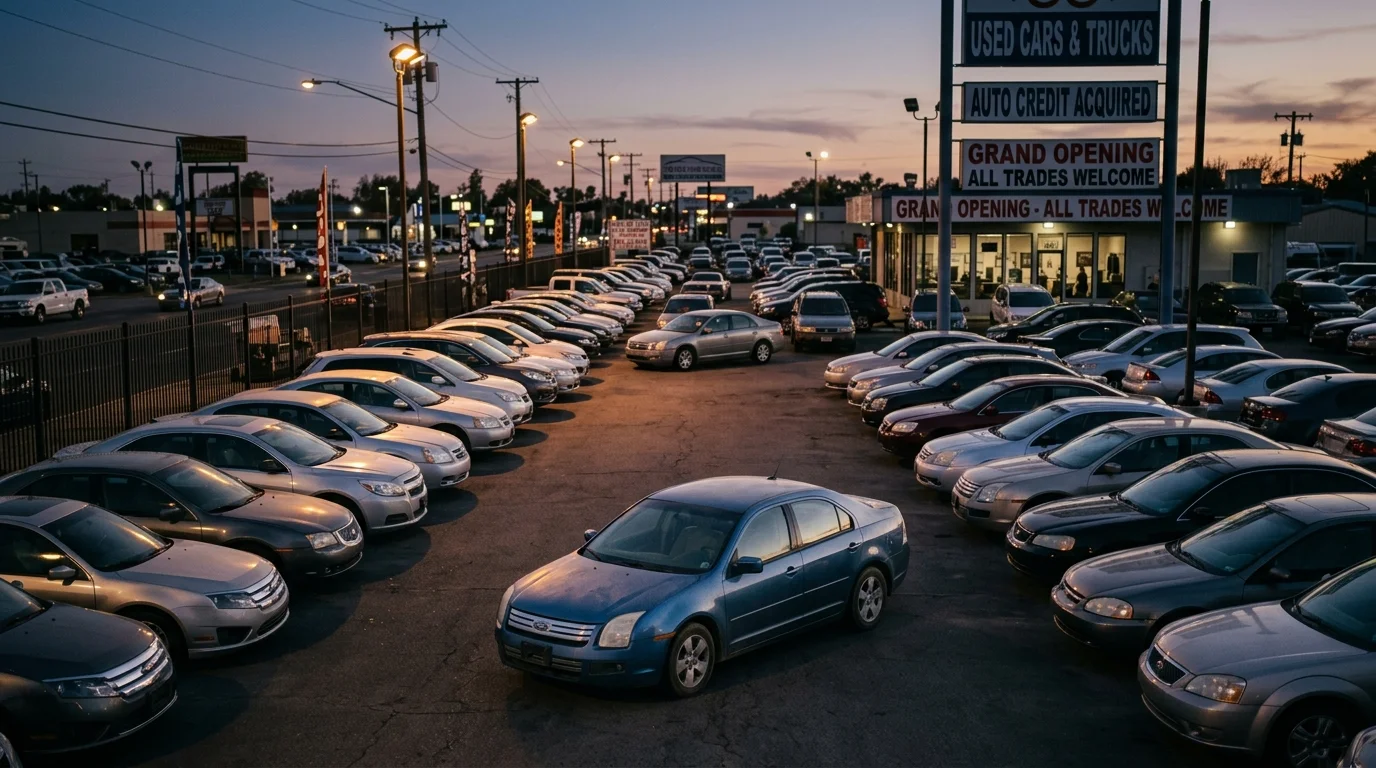
The traditional path to professional car photography has always demanded significant investment. Dealerships and auto sellers typically face two costly options: hiring a professional photographer at $30–$50 per vehicle, or investing $25,000–$60,000 in a physical studio booth setup. Yet even with these expenses, inconsistency plagues inventory photos—cluttered lot backgrounds, parked cars, signage, and other distracting elements undermine the polished presentation buyers expect online.
This is where AI-powered object removal transforms the equation. By leveraging intelligent background removal and replacement technology, dealerships can now convert ordinary lot photos into studio-quality images in seconds, eliminating the need for expensive equipment or lengthy photoshoots. The concept is straightforward but powerful: AI erases unwanted elements and replaces backgrounds with professional, curated options—turning a snapshot taken on any smartphone into a showroom-ready asset.
Quick Answer:
AI object removal works by using machine learning algorithms to detect and isolate vehicles from their backgrounds, then seamlessly replace those backgrounds with professional studio options or clean, neutral environments. For auto sellers, this means eliminating costly studio setups and photographer fees while maintaining consistent, high-quality visuals across entire inventory. The technology delivers 4K-resolution images in under 10 seconds at a fraction of traditional photography costs—typically $3–$7 per image instead of $30–$50.
This article explores how background removal and AI-powered photo enhancement are reshaping automotive marketing. You'll discover the practical benefits for dealerships, the mechanics behind modern AI erasers, real-world implementation strategies, and how solutions like professional car backgrounds are redefining what's possible in digital automotive sales.
Table of Contents
- The Traditional Cost of Professional Car Photography vs. AI Solutions
- Why Studio Setups Fail for High-Volume Dealerships
- The Hidden Costs of Hiring Photographers
- How AI Object Removal Works in Automotive Photography
- Object Detection: Identifying What Needs to Be Removed
- Intelligent Removal and Background Replacement
- Key Benefits of AI Object Removal for Different Automotive Businesses
- For Dealerships: Consistency and Scale
- For Turo Hosts and Individual Sellers
- For Car Photographers: Efficiency and Client Value
- Evaluating AI Object Removal Tools: What to Look For
- Accuracy and Quality Standards
- Ease of Use and Automation
- Pricing and ROI Calculation
- Real-World Impact: How Dealerships Improved Listings with AI Object Removal
- Making the Shift to AI-Powered Car Photography in 2026
The Traditional Cost of Professional Car Photography vs. AI Solutions
Why Studio Setups Fail for High-Volume Dealerships
Physical photography studios represent a massive upfront investment that most dealerships cannot justify. According to Dealermade Pricing, professional automotive photography equipment ranges from $20,000–$25,000 for a basic setup, with monthly rental costs starting at $1,350–$1,717 for automated systems. Even renting studio space carries daily fees between $200 and $1,500, depending on equipment quality and location.
The real problem isn't just the initial cost—it's scalability. A dealership with 100 vehicles in inventory cannot photograph them all in a single day, even with a dedicated studio. Studios can typically handle 5–10 vehicles per day under ideal conditions. This means a 200-car lot requires weeks of continuous shooting to refresh inventory, during which new vehicles arrive and old stock sits unphotographed. The result: inconsistent visual presentation across your catalog, with some cars looking professional while others appear dated or poorly lit. Buyers notice this immediately and lose confidence in your operation.
The Hidden Costs of Hiring Photographers
When dealerships outsource photography, the per-vehicle expense adds up quickly. According to DealerRefresh Automotive Dealer Forums, dealerships typically pay between $10–$30 per vehicle for professional car photography, with standard rates around $15–$20 per vehicle in 2025. For a 100-car inventory refresh, that's $1,500–$3,000 in labor alone—and that's before scheduling delays, travel time, or rush fees.
Beyond per-car pricing, professional photographers charge $50–$300 per hour, with top-tier specialists commanding $250–$500 per hour. Scheduling becomes a logistical nightmare: photographers book weeks in advance, weather delays shoots, and editing takes days. Meanwhile, your inventory sits in the lot without updated photos. Even worse, different photographers produce inconsistent results—varying lighting, angles, and editing styles that make your dealership look disorganized. One car might have warm, inviting tones while another appears cold and clinical, undermining brand consistency across your entire online presence.
This inconsistency directly impacts buyer behavior. When customers see a cohesive, professional photo gallery, they perceive higher quality and are more willing to visit or make an inquiry. When photos vary wildly in style and quality, buyers question whether the dealership maintains its vehicles with the same care.
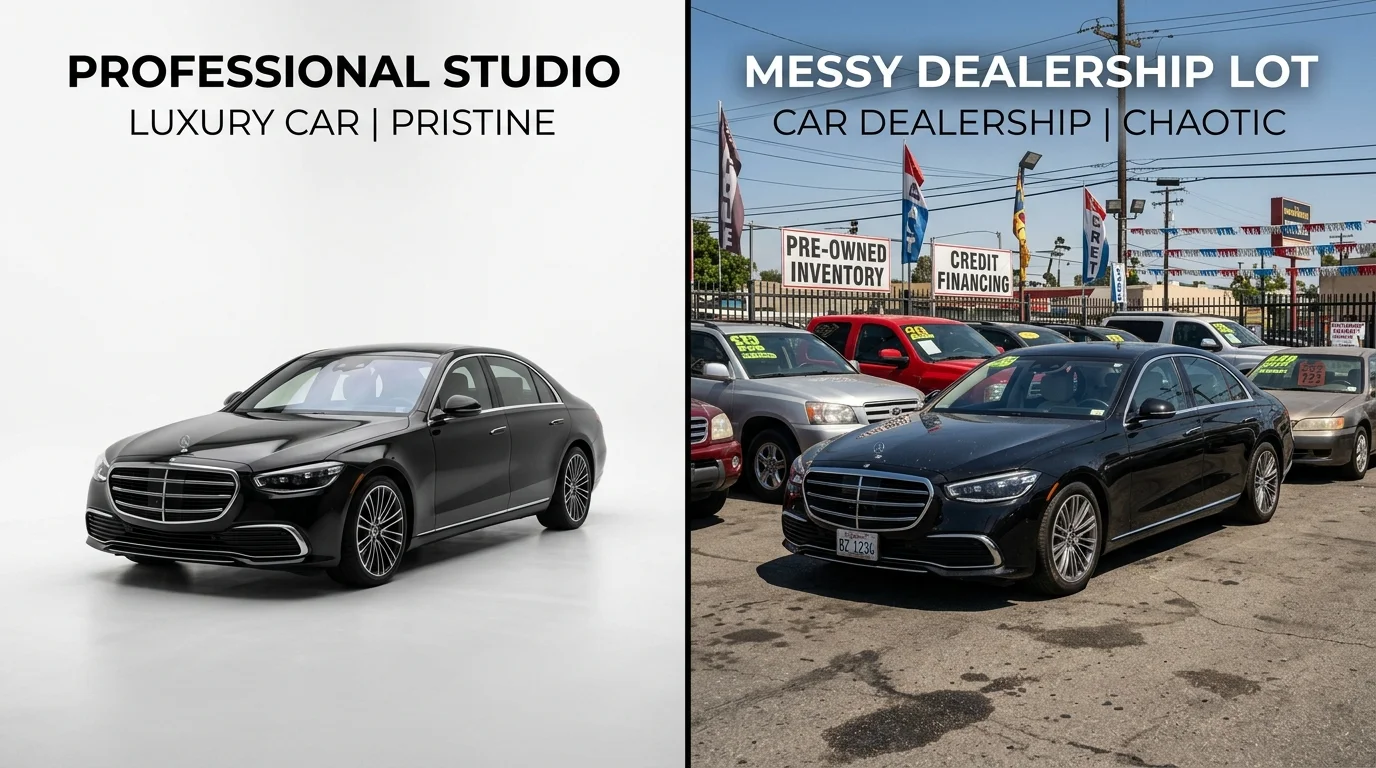
The Math: A 200-car dealership refreshing inventory twice yearly at $20 per car pays $8,000 annually just for photography. Add studio rental ($1,500/month × 12 = $18,000) and you're at $26,000 per year—before considering scheduling delays, inconsistent quality, or the opportunity cost of staff time coordinating shoots.
AI object removal tools eliminate these constraints entirely. By processing lot photos in under 10 seconds at $3–$7 per image, dealerships reduce annual photography costs by 75–90% while gaining complete control over background consistency and turnaround speed. Every vehicle receives the same professional treatment instantly, without scheduling conflicts or editing delays.
How AI Object Removal Works in Automotive Photography
Object Detection: Identifying What Needs to Be Removed
Modern AI systems analyze car photos pixel-by-pixel to identify unwanted elements with remarkable precision. These algorithms recognize patterns—reflections in windows, license plates, watermarks, other vehicles in the background, people, studio equipment, or lot clutter—by comparing them against millions of training examples. The AI doesn't simply look for "things that don't belong"; it understands context. It knows that a license plate is separate from the vehicle body, that a person standing beside a car is distinct from the car itself, and that a logo on a dealership sign differs from the vehicle's own branding.
This contextual understanding is critical. A naive eraser tool might accidentally blur part of the car's trim or chrome while removing a nearby object. Intelligent detection systems preserve vehicle integrity by creating precise boundaries around what should stay and what should go. When you photograph a car on a busy lot—with competing vehicles, signage, and distractions surrounding it—the AI isolates your vehicle as the primary subject and flags everything else for removal.
Intelligent Removal and Background Replacement
Once unwanted objects are identified, deep learning algorithms fill the removed areas by analyzing surrounding pixels and predicting what should logically appear in that space. If you remove a person standing in front of a car, the system doesn't just blur the area; it reconstructs the background behind them based on visual context. The result looks natural, not obviously "edited."
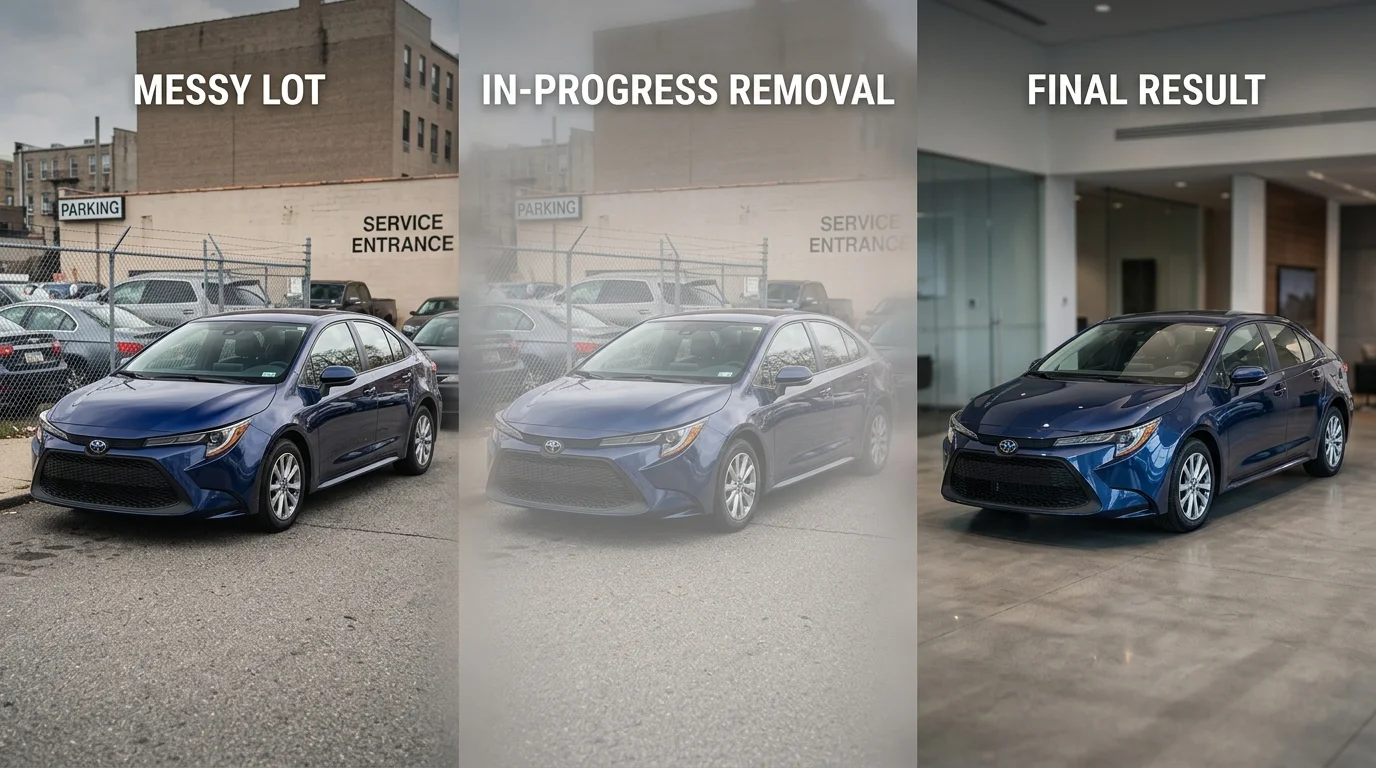
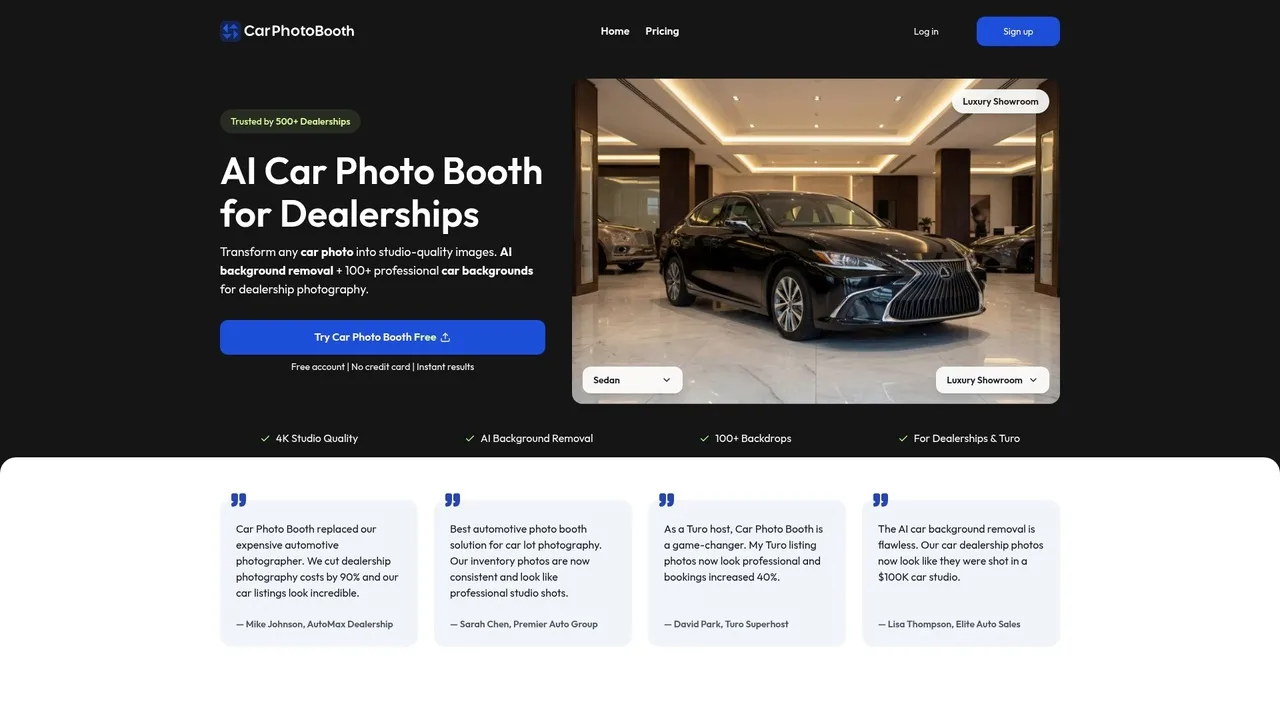
The real power emerges when removal pairs with background replacement. Rather than leaving a transparent void or a reconstructed lot background, dealerships can instantly swap in one of 100+ professional environments—a luxury showroom, pristine white studio backdrop, urban street, scenic landscape, or branded dealership setting. This transformation happens in under 10 seconds. Every vehicle receives the same polished treatment: consistent lighting, professional composition, and zero distractions. The car becomes the undeniable focal point, which is precisely what drives buyer engagement and inquiry rates.
Tools like Car Photo Booth automate this entire workflow, allowing dealerships to process inventory in bulk without manual editing or scheduling studio time. The consistency alone—every car photographed against identical professional backdrops—builds brand credibility that lot photos simply cannot match.
Key Benefits of AI Object Removal for Different Automotive Businesses
AI-powered object removal and background replacement deliver distinct competitive advantages across the automotive sales ecosystem. Rather than a one-size-fits-all solution, the technology addresses specific pain points for dealerships, individual sellers, and professional photographers—each with measurable outcomes that directly impact revenue and operational efficiency.
For Dealerships: Consistency and Scale
Large dealerships manage hundreds of vehicles across multiple lots, and maintaining visual consistency across inventory has traditionally required either expensive studio time or accepting the visual chaos of lot photography. AI object removal solves this at scale. A dealership with 200 vehicles can process its entire catalog in a single day instead of spreading photography across two weeks. Every vehicle receives identical professional treatment: consistent lighting, studio-quality backgrounds, and zero distracting elements like other cars, signage, or weather conditions in the frame.
This uniformity builds brand credibility. When a buyer scrolls through listings and sees 50 vehicles photographed against the same pristine showroom backdrop or luxury environment, they perceive professionalism and trustworthiness. According to research from Redline Advantage, dealerships that switched from in-house photos to professional photo services typically see a 25-40% increase in listing click-through rate. AI-powered background replacement achieves this consistency without the cost or scheduling complexity of traditional studios. Inventory turns faster because listings appear more compelling, and sales teams spend less time managing photography logistics and more time closing deals.
For Turo Hosts and Individual Sellers
Turo hosts and private sellers operate under different constraints than dealerships: they need professional-looking listings quickly, affordably, and without hiring photographers. A Turo host with five vehicles to rent cannot justify a $5,000 studio shoot, yet their listing quality directly determines rental inquiries and competitive positioning on the platform.
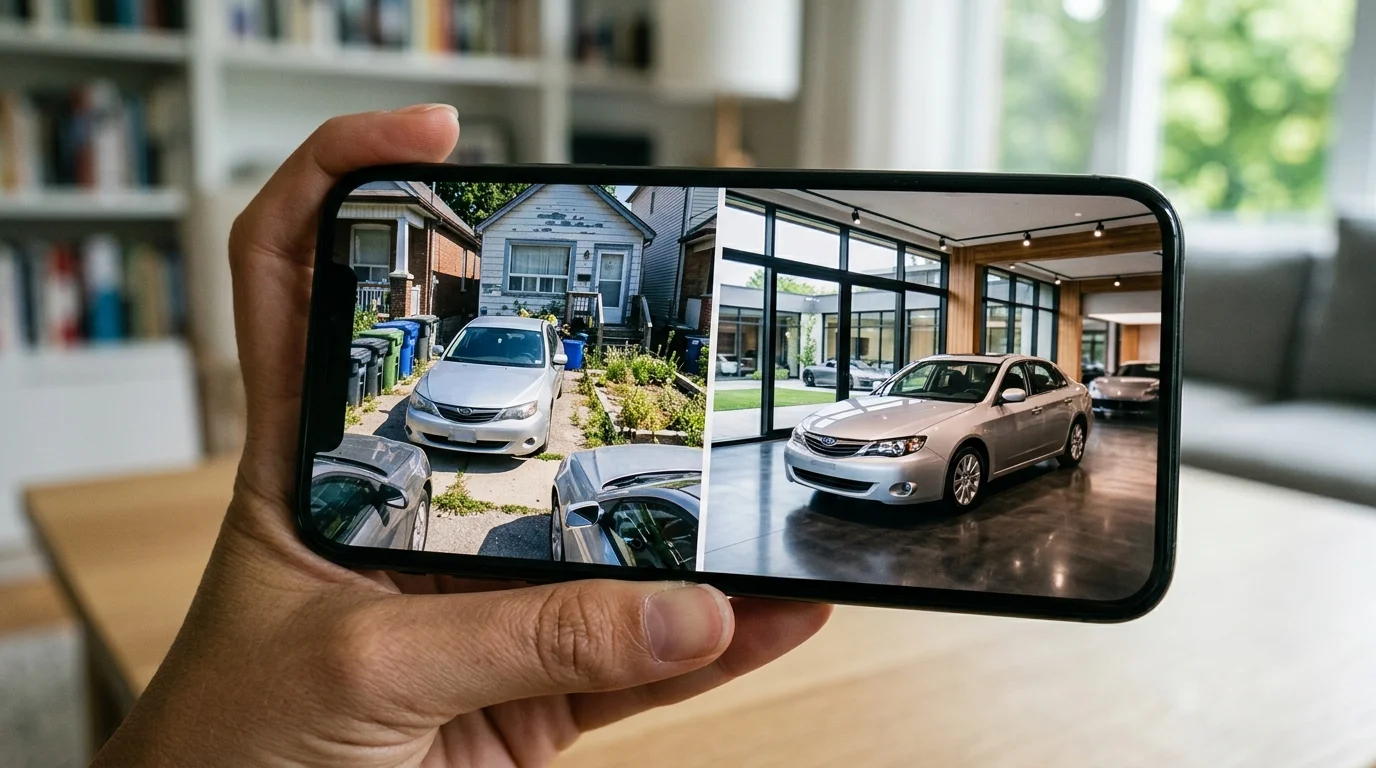
AI object removal eliminates this barrier. A host can photograph vehicles in their driveway or parking lot—imperfect lighting, messy backgrounds, other cars visible—and transform those raw shots into studio-quality images within minutes. The distracting background disappears, replaced by a luxury showroom or scenic landscape that positions the vehicle as premium. This turnaround speed is critical: a seller can list a newly acquired vehicle within hours rather than waiting for photographer availability. The competitive advantage is immediate—professional-looking listings attract more inquiries, command higher rental rates, and reduce time-to-first-booking.
For Car Photographers: Efficiency and Client Value
Professional automotive photographers face a paradox: clients demand studio-quality results at competitive prices, but delivering those results traditionally requires expensive equipment, studio rental, and hours of post-processing per vehicle. AI object removal reframes the photographer's workflow and value proposition.
Instead of spending 2-3 hours editing a single vehicle—removing distracting elements, reconstructing backgrounds, color-correcting—photographers can process the same work in 15-20 minutes using AI tools. This efficiency allows photographers to take on more clients without scaling their team or overhead. More importantly, it frees time for higher-value services: custom background selection, vehicle retouching, multi-angle composition planning, or creating marketing collateral beyond simple listing photos. Photographers can offer premium packages—"luxury showroom package," "lifestyle background collection," "4K gallery sets"—that command higher margins because the baseline editing work is automated. Clients perceive faster turnaround and more polished results, improving satisfaction and repeat business.
The measurable outcome across all three segments is identical: faster listing creation (seconds versus hours), dramatically reduced per-image costs, and improved online visibility. When Google Vehicle Listing Ads with professional photos achieve 67% lower cost-per-click compared to standard search ads, the ROI of professional-quality imagery becomes undeniable. AI object removal democratizes access to that quality, eliminating the traditional gatekeeping of studio photography and allowing dealerships, Turo hosts, and photographers to compete on visual presentation rather than budget.
Evaluating AI Object Removal Tools: What to Look For
Selecting the right AI object removal solution requires understanding what separates a tool that merely erases backgrounds from one that delivers professional, market-ready results. The decision framework differs significantly depending on whether you're a solo photographer handling a dozen cars monthly or a dealership processing hundreds of listings weekly. The stakes are higher than they appear: a poor background removal can undermine your entire visual marketing strategy, while the right tool becomes a competitive advantage that compounds over time.
Accuracy and Quality Standards
The foundation of any AI photo editing tool is detection precision. Modern neural networks identify vehicle edges, reflections, shadows, and complex details like chrome trim or glass with varying degrees of success. When evaluating a tool, test it against your own inventory—not the vendor's curated examples. Upload photos taken in different lighting conditions: overcast lot shots, bright sunlight, indoor showroom images, and evening photos. Pay attention to edge quality around wheels, mirrors, and antenna. Does the AI leave ghosting artifacts or white halos around the vehicle? Does it accidentally erase parts of the car itself, like a portion of a bumper or side trim?
The second dimension is background replacement quality. A tool might remove the background perfectly but then composite a replacement that looks flat, poorly lit, or misaligned with the vehicle's shadow and perspective. Professional-grade solutions account for lighting direction, vehicle angle, and shadow casting. Car Photo Booth addresses this through its library of over 100 professionally photographed backgrounds—showroom interiors, luxury dealership settings, urban environments, and natural landscapes—each designed to integrate seamlessly with automotive subjects. The backgrounds aren't generic overlays; they're pre-lit to match common vehicle photography scenarios, reducing the post-processing burden on your end.
Ease of Use and Automation
Non-technical users need one-click simplicity. If your tool requires learning curves—adjusting masks, fine-tuning parameters, or understanding color spaces—you've already lost the time savings that made AI automation attractive in the first place. The best solutions operate on a principle of intelligent defaults: upload, select a background, export. No learning required.
Batch processing capability becomes critical at scale. A photographer handling five cars can process them individually. A dealership with 50 new arrivals weekly needs to upload a folder and walk away while the system processes all images in parallel. Look for tools that support bulk uploads, background assignment across batches, and automated export to your preferred resolution or file format. This single feature can reduce processing time from hours to minutes, freeing your team for higher-value tasks like composition planning or vehicle retouching.
Pricing and ROI Calculation
The math is straightforward but often overlooked. Traditional photographer fees range from $30–50 per vehicle, with setup costs for studio space, lighting, and equipment running $25,000–60,000 upfront. AI solutions cost as little as $3 per car through subscription models, with zero equipment investment. For a dealership processing 100 vehicles monthly, the annual savings exceed $30,000 compared to hiring photographers—before accounting for the eliminated studio overhead.
When comparing pricing models, distinguish between per-image costs and subscription tiers. A $7/month plan supporting 15 photos works for small operations; a $99/month enterprise plan supporting unlimited processing serves high-volume dealers. Calculate your true cost per image by dividing monthly subscription cost by expected monthly output. If you process 200 cars monthly at $99/month, your per-car cost is under $0.50—a fraction of traditional methods. Factor in time savings: if your team currently spends 2 hours per week on photo editing, and AI automation eliminates that, you've recovered the subscription cost through labor alone within the first month.
Real-World Impact: How Dealerships Improved Listings with AI Object Removal
The transition from traditional photography workflows to AI-powered solutions produces measurable shifts in operational efficiency and market performance. Dealerships that embraced AI-powered automated background editing saw a 30% increase in sales, proving that professional automotive imagery directly influences buyer behavior and conversion rates.
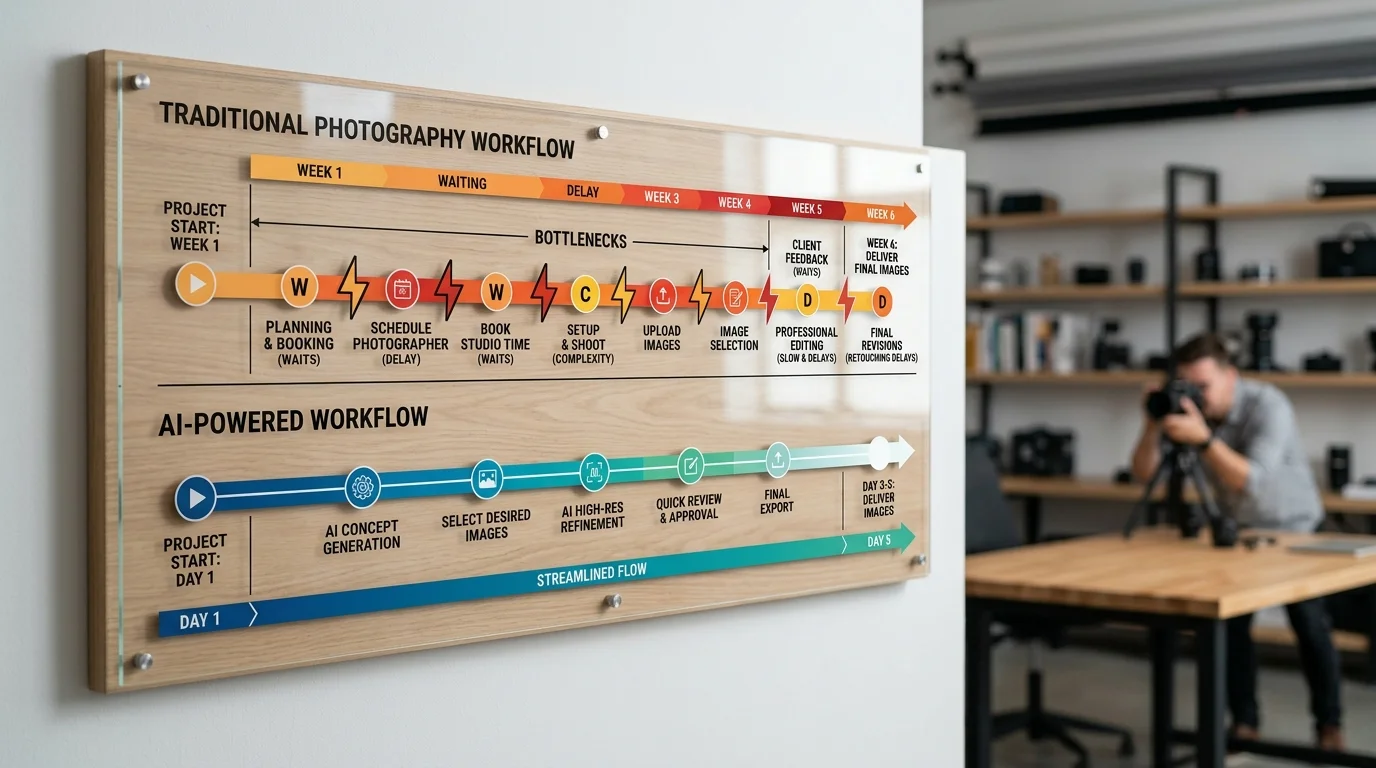
Consider the typical high-volume dealership scenario: a 150-unit lot requiring professional photography for online listings. Traditionally, this demands 4–6 weeks of photographer scheduling, studio time, and post-processing labor. With AI object removal and background replacement, the same inventory processes in 3–5 days. A dealership processing 300 vehicles quarterly reduces turnaround from six weeks to three days—a timeline compression that accelerates listing publication across AutoTrader, Craigslist, and proprietary inventory systems.
Turo hosts and independent sellers experience equally compelling results. Professional-looking vehicle photography directly correlates with rental inquiry volume. Hosts who replaced lot-photo backgrounds with studio-quality alternatives report 25–35% increases in inquiry rates within the first month. The mechanics are straightforward: cleaner, more professional imagery reduces friction in the buyer's decision journey and signals vehicle quality before contact.
For automotive photographers managing multiple clients, AI solutions expand capacity without proportional labor increases. A photographer handling 20 vehicles weekly can absorb 40–50 with the same team by automating background removal and replacement tasks. This scalability translates to higher revenue per photographer and faster client turnaround—competitive advantages in a price-sensitive market.
The underlying driver is consistency. Traditional photography produces variable results depending on lighting conditions, lot cleanliness, and photographer skill. AI ensures every vehicle receives identical professional treatment, eliminating the visual inconsistency that damages dealership credibility. When customers browse a lot's online inventory and see uniform, polished imagery, trust increases and time-to-sale contracts measurably.
Making the Shift to AI-Powered Car Photography in 2026
The automotive sales industry is at an inflection point. What was once a luxury—professional, studio-quality vehicle photography—is rapidly becoming the baseline expectation. Dealerships, Turo hosts, and independent sellers who continue relying on traditional photography methods are losing competitive ground to those who've adopted AI-powered solutions. The shift isn't theoretical; it's happening now, and the advantage belongs to early movers.
AI object removal and background replacement solve the three problems that have plagued automotive photography for decades: cost, speed, and consistency. A traditional studio shoot demands $25,000–$60,000 in equipment investment plus ongoing overhead. Professional photographers charge $30–$50 per vehicle. Lot photos vary wildly depending on weather, lighting, and the cleanliness of your inventory lot. AI eliminates all three friction points. You process photos in seconds, maintain identical professional treatment across your entire catalog, and reduce per-image costs to a fraction of traditional methods. The economics are undeniable, and they're driving rapid adoption across the industry.
The real competitive advantage, however, lies in speed and scalability. When you can transform 50 lot photos into studio-quality assets in under an hour—with zero manual editing—you unlock capacity that traditional workflows simply cannot match. You list inventory faster, respond to market demand quicker, and maintain fresher catalogs. For dealerships managing hundreds of vehicles, this translates directly to higher sales velocity and reduced time-on-lot costs.
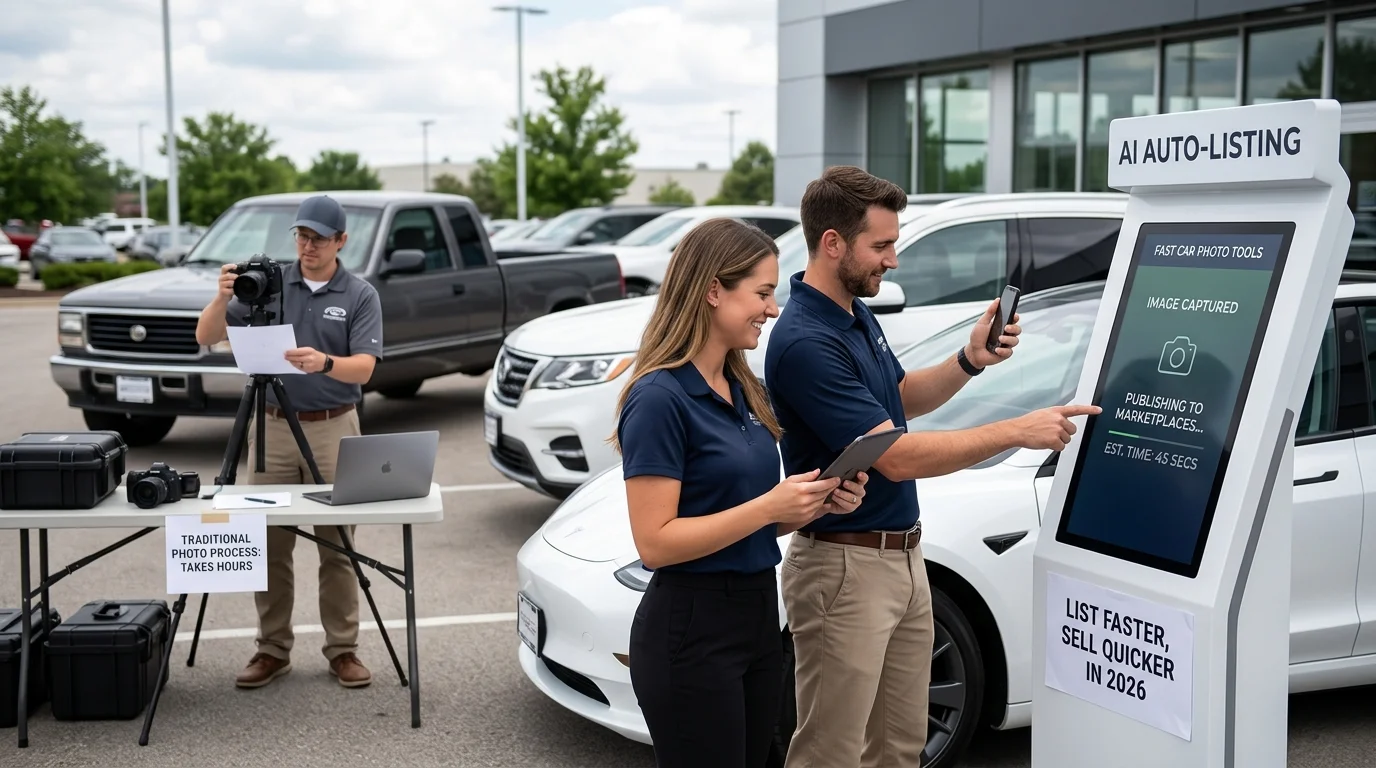
Getting started requires no technical expertise. Professional car photo backgrounds and AI solutions eliminate the learning curve entirely—upload a photo, select a backdrop from over 100 professional options, and export in 4K quality. No credit card needed to test the platform. The dealership or seller that delays adoption is essentially ceding market share to competitors who've already standardized on this technology. The question is no longer whether to transition to AI-powered car photography, but how quickly you can implement it.