
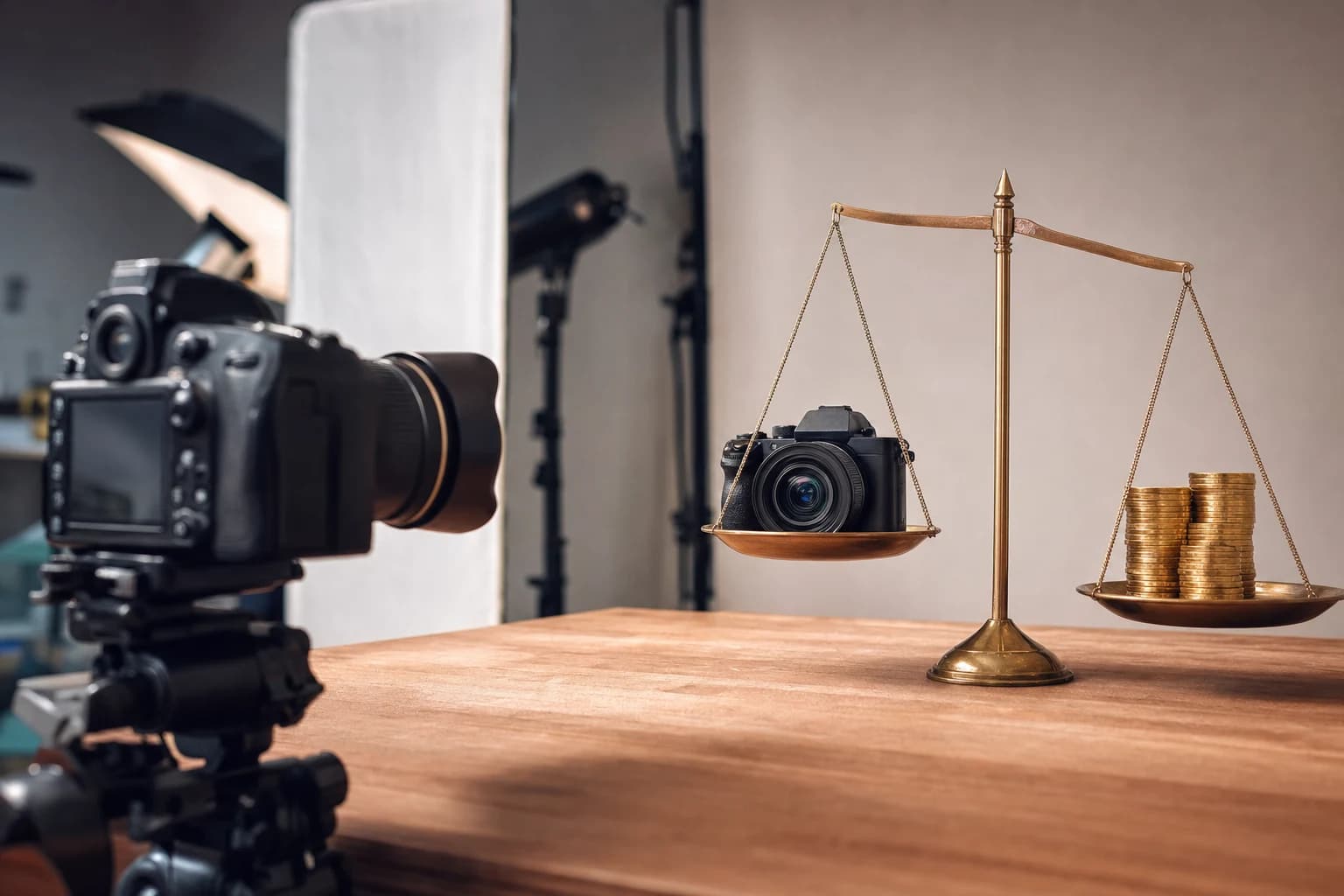
Professional automotive photography remains one of the largest operational expenses for dealerships, rental platforms, and independent sellers. Whether you're creating inventory photos for online listings or assembling a cohesive brand catalog, the cost of product photography—particularly professional car photos—can rapidly deplete marketing budgets. Traditional studio shoots demand premium hourly rates, travel logistics, and editing timelines spanning days. AI-powered solutions, by contrast, compress these workflows into moments.
This fundamental tension between quality, cost, and speed defines automotive photography strategy in 2026.
Quick Answer: Professional automotive photography costs range from $50 to $200 per image for traditional studios, with full-day commercial rates reaching $10,000 according to FrameOnce's 2026 pricing analysis. AI background replacement platforms deliver studio-quality results for a fraction of that cost—typically $0.50 to $5 per image—making them ideal for dealers needing rapid, consistent catalog updates at scale.
This guide compares both approaches across cost, turnaround time, image consistency, and real dealership use cases, helping you determine which photography strategy aligns with your 2026 business goals.
Table of Contents
- Common Product Photography Pricing Models Explained
- AI-Powered Photography vs. Traditional Methods: Cost and Performance Comparison
- Hidden Costs in Product Photography Pricing: What's Really Included
- How to Budget and Choose the Right Photography Solution in 2026
- Common Questions About Product Photography Pricing for Car Dealers
- Making Smart Photography Decisions for Your Automotive Business
Common Product Photography Pricing Models Explained
Automotive photographers employ three distinct pricing structures, each optimized for different inventory volumes and production workflows. Understanding which model aligns with your dealership's needs—whether you're managing a small rotating inventory or staging dozens of vehicles monthly—directly impacts your production timeline and per-unit costs.
Per-Image Pricing: Cost and Best Use Cases
Per-image pricing charges a fixed rate for each completed photo. According to DealerRefresh Forum discussions, per-vehicle photography rates range from $7 to $50 depending on scope—basic pre-recon shots start at $5–7 per vehicle, while full staging with 50+ angles and editing reaches $50 per vehicle. For a 50-vehicle dealership, basic per-image pricing translates to $350–2,500 for a complete refresh.
This model works best for dealers with occasional inventory updates, small lots, or inconsistent shooting schedules. You pay only for what you need, without committing to hourly blocks. However, per-image pricing can become expensive at scale if you're photographing dozens of vehicles simultaneously.
Hourly and Day-Rate Models for Large-Scale Shoots
Hourly rates compress costs when shooting multiple vehicles in a single session. Per FrameOnce's 2026 pricing analysis, hourly rates span $50–$150 per hour for entry-level photographers to $150–$500 per hour for experienced specialists. A typical 4-hour professional automotive session costs approximately $800, reducing the effective per-vehicle cost if you're capturing 15–20 cars in one shoot.
Day rates ($1,000–$3,000+) further reduce unit costs for high-volume inventory refreshes. Photographers handle styling, multiple angles, and same-day editing as a unified package, creating visual consistency across your catalog. Day rates become economical once you're shooting 20+ vehicles at once.
| Pricing Model | Cost Per Vehicle | Best For | Total Cost (50 vehicles) |
|---|---|---|---|
| Per-Image | $7–$50 | Small lots, occasional updates | $350–$2,500 |
| Hourly Rate | $50–$500/hr (~$3–$25/vehicle in bulk) | Medium inventories, 10–20 vehicles/shoot | $1,500–$4,000 |
| Day Rate | $1,000–$3,000/day (~$20–$60/vehicle) | High-volume dealers, 20+ vehicles/day | $1,000–$3,000 |
| Package/Subscription | $0.50–$5/image (AI tools) | Unlimited updates, consistent branding | $25–$250 |
AI-powered background replacement tools like Car Photo Booth eliminate the pricing ceiling entirely—dealers process unlimited photos at a fraction of traditional studio costs while maintaining studio-quality results.
The divergence between traditional logistical burdens and digital efficiency defines modern pricing strategies.
AI-Powered Photography vs. Traditional Methods: Cost and Performance Comparison
The pricing gap between traditional automotive photography and modern AI-powered alternatives has become decisive. While professional photography remains a cornerstone of inventory presentation, the economics increasingly favor solutions that scale without proportional cost increases.
Traditional Studio Photography: Complete Cost Breakdown
Professional car photography combines multiple expenses into a single large outlay. Studio rental runs $200–$500 per day, photographer fees typically $1,500–$5,000 per shoot, and prop styling adds another $300–$800. Retouching—essential for removing reflections, adjusting lighting, and creating consistency—adds 30–50% to the production cost. For a dealership photographing 50 vehicles, the total investment reaches $5,000–$15,000 once you account for multiple angles per car, same-day editing, and file delivery. Turnaround typically spans 3–7 days. Revisions carry additional charges, and scaling becomes exponentially more expensive as inventory grows.
AI Solutions: Subscription Model and Per-Image Economics
AI photo tools operate on fundamentally different economics. According to Spyne's analysis, manual car photo editing runs between $45 and $120 per vehicle, while AI batch processing operates at under $0.50 per image at standard volume. Subscription models typically range from $50 to $300 monthly depending on features and volume, per CarBackground.ai, with no capital expenditure required unlike physical photo studios. The same 50-vehicle inventory now costs $25–$250 depending on subscription tier, with processing taking minutes rather than days. Unlimited revisions eliminate per-change fees, and the same subscription scales to 500 vehicles without increased costs.
| Metric | Traditional Studio | AI-Powered Solutions |
|---|---|---|
| Cost per Vehicle | $100–$300 | $0.50–$5 |
| Setup/Monthly Cost | $5,000–$15,000/shoot | $50–$300/month |
| Turnaround Time | 3–7 days | Minutes |
| Scalability | Linear cost increase | Unlimited at flat rate |
| Revision Cost | $25–$100 per change | Unlimited |
| Best For | Hero shots, flagship campaigns | Inventory consistency, rapid refreshes |
The shift toward cost-effective photography solutions reflects a practical reality: dealerships achieve professional-quality results—with background replacement and retouching—at a fraction of traditional overhead while gaining speed and scalability that studio photography cannot match. Where traditional methods lock inventory into periodic refresh cycles, scalable AI alternatives enable dealers to update 100 vehicles daily at the same subscription cost as 10.
Time is the ultimate currency: AI transforms raw assets into market-ready inventory in minutes.
Hidden Costs in Product Photography Pricing: What's Really Included
The $100–$300 per-vehicle quote from traditional photographers masks a deeper cost structure. According to research from Nightjar, professional retouching adds 30–50% to base photography costs, with the effective price per image often running close to double once hidden expenses are factored in.
Beyond the session fee, dealerships encounter:
- Post-production and retouching – Color correction, background removal, shadow enhancement, dust removal
- Studio or location rental – Hourly or daily facility costs ($500–$3,000+ per shoot)
- Props and styling – Additional backgrounds, lighting equipment, or set dressing
- Rush-order premiums – 20–40% markup for expedited turnaround
- Licensing and usage rights – Restrictions on how photos can be distributed across platforms
- Travel and logistics – Mileage, tolls, or transportation for on-location shoots
Post-Production and Retouching: The Often-Hidden Expense
Retouching represents the largest invisible cost layer. After the shoot ends, images enter the editing pipeline: color grading ensures consistency across the inventory, background removal isolates the vehicle, shadows are sculpted for dimension, and blemishes are erased. Each vehicle typically requires 30–60 minutes of skilled labor at $50–$150/hour. For a 20-vehicle shoot, this adds $500–$1,800 to the invoice.
This friction vanishes with AI-powered solutions. Background replacement and retouching automation eliminates post-production bottlenecks entirely. Tools like Car Photo Booth process vehicles in seconds, applying professional-grade edits at zero additional cost per image—whether you're processing 10 cars or 1,000.
The real cost difference is not in the headline rate, but in what lies beneath. Traditional photography's hidden expenses compound monthly; AI's flat-rate subscription absorbs unlimited volume at a predictable overhead.

Beneath the surface of a simple quote lies the heavy weight of hidden logistical and editing costs.
How to Budget and Choose the Right Photography Solution in 2026
The decision between traditional automotive photography and AI-powered alternatives depends less on philosophical preference and more on ruthless financial clarity. Choosing a photographer—or a photography solution—requires understanding your inventory rhythm, growth trajectory, and realistic return expectations.
Calculating Return on Investment for Photography Spending
Professional automotive images directly impact buyer behavior. According to research from BlendNow and Shopify, high-quality photography delivers up to a 33% increase in conversion rates compared to low-quality images. For dealers leveraging AI automotive photography tools, the gains compound: cars photograph with consistency command 3% higher prices on average, while standstill time—the days a vehicle sits unsold—drops by approximately 3 days per unit.
Calculate your photography ROI simply: multiply average vehicle profit margin by conversion rate lift, then subtract photography costs. A 20-vehicle monthly inventory at $2,000 average margin, with a 30% conversion lift, generates $12,000 in additional gross profit monthly. Against that baseline, even comprehensive photography investment becomes breakeven within weeks, not months.
Key Questions to Ask Before Committing to a Photography Service
Before signing any contract or subscription agreement, audit these critical variables:
- Volume scalability: Can the service handle 10 vehicles this month and 100 next month without price friction?
- Turnaround time: Is the timeline compatible with your listing velocity? (Most dealers need 24–48-hour delivery.)
- Usage rights: Who owns final images? Can you resell the vehicle and reuse photos for advertising?
- Revision policy: What's included in the quoted price? Are background swaps, color corrections, or image healing unlimited?
- Technical integration: Does the service integrate with your inventory management system, or is it manual upload-and-download friction?
- Hidden fees: Does per-vehicle pricing include retouching, rush fees, or mileage surcharges?
Honest pricing comparison favors solutions where cost decreases per unit as volume grows—a hallmark of AI-native tools. Traditional photography typically scales linearly: more cars means proportionally higher invoices. AI platforms, by contrast, operate on fixed monthly subscriptions, making the photography budget predictable regardless of inventory growth.
Navigating the right photography strategy requires a clear focus on long-term ROI and scalability.
Common Questions About Product Photography Pricing for Car Dealers
How much should I pay per car photo?
Traditional studio photography typically ranges $100–$300 per vehicle, but this scales linearly—50 cars means a proportional cost increase. AI-powered solutions operate on fixed monthly subscriptions ($29–$99), making photography costs predictable regardless of inventory size. True cost comparison favors volume: at 50+ vehicles monthly, AI solutions cost roughly $0.50–$2.00 per image.
Is professional car photography worth the cost?
Yes, if it drives higher conversion rates and reduces time-to-sale. Professional images increase click-through rates by 30–50% compared to smartphone photos. However, the method matters—traditional photography requires scheduling, travel, and retouching turnaround. AI-native tools like background replacement technology deliver studio-quality results instantly without logistics friction.
What's the typical turnaround?
Traditional photographers: 3–7 days. AI platforms: seconds to minutes.
How does AI quality compare to traditional photography?
AI excels at consistency and speed, but struggles with extreme angles or damaged vehicles. Traditional photography offers superior artistry for premium inventory. The hybrid approach—AI for volume, professional photography for flagship listings—balances cost and quality effectively.
Making Smart Photography Decisions for Your Automotive Business
Photography costs for automotive inventory span a spectrum defined by method, volume, and complexity. Traditional photography remains viable for premium, flagship listings where artistic direction justifies $100–$300 per vehicle. However, the economics shift decisively when scale enters the equation. Dealers, Turo rental hosts, and high-volume auto businesses operating with 50+ monthly vehicle listings face a stark reality: traditional photography becomes a bottleneck and budget drain.
AI-powered solutions have fundamentally reframed this decision. At $29–$99 monthly subscriptions with unlimited processing, per-image costs drop to $0.50–$2.00 at volume—a 90% reduction compared to traditional methods. Beyond raw pricing, AI eliminates hidden costs entirely: no scheduling friction, no photographer logistics, no multi-day turnarounds, no quality inconsistencies across shoots. When you need studio-quality results in seconds rather than days, scalable alternatives powered by AI background replacement and professional staging become the obvious choice.
The 2026 trend is clear: AI adoption in automotive photography is accelerating. Dealerships that resisted two years ago now recognize it as essential infrastructure, not experimental technology. The hybrid approach—AI for volume and consistency, professional photography for select premium inventory—represents the pragmatic evolution of automotive marketing strategy.
Your decision ultimately depends on ruthless financial analysis: How many vehicles monthly? What's your time-to-market pressure? Can you absorb scheduling delays? If your answer suggests high volume or tight timelines, evaluating AI-powered editing tools designed specifically for dealerships is no longer optional—it's competitive necessity. The cost-effectiveness and speed of modern automotive photography solutions have eliminated the trade-off between budget and quality.