

Professional car photography is no longer a luxury—it's a necessity in 2026’s digital-first automotive marketplace. With 90% of car shoppers eliminating vehicles from consideration based solely on photo quality, first impressions are made on screens, not showroom floors. High-quality visuals directly influence buyer trust, engagement, and conversion, making it critical for dealerships, Turo hosts, and auto businesses to present vehicles with consistent, studio-grade imagery—without the studio price tag.
Quick Answer: AI-powered tools like Car Photo Booth now automate professional photo editing services by instantly removing backgrounds and replacing them with high-end studio, white, urban, or natural scenes. These online photoshop services deliver results in seconds, eliminating the need to hire photo editing experts or schedule costly photoshoots.
This article explores the top AI tools transforming car photo editing, comparing features, pricing, and efficiency. We’ll show how AI outperforms traditional professional Photoshop services and manual editing, and why solutions like AI-powered background replacement are becoming essential for modern auto marketing.
Table of Contents
- Top 5 AI Tools to Edit Car Photos in 2026
- How AI Photo Editing Beats Traditional Methods in 2026
- Key Features to Look for in 2026’s Car Photo Editing Tools
- How to Use Car Photo Booth to Edit Real Estate Photos (Yes, Cars Too)
- When to Hire a Human Editor vs. Using AI in 2026
- Final Verdict: The Future of Car Photo Editing Is AI in 2026
Top 5 AI Tools to Edit Car Photos in 2026
Selecting the right AI tool for automotive image editing requires more than just aesthetic appeal—it demands precision, speed, and scalability. We evaluated platforms based on automation depth, output quality, processing speed, pricing transparency, and suitability for high-volume automotive use cases like dealership inventory or Turo listings. The top solutions eliminate manual editing entirely, offering one-click background removal, intelligent lighting correction, and seamless integration of professional studio scenes. These tools are redefining how auto businesses handle visual content, replacing costly outsourcing to professional photo editors or freelancer photo editing services with instant, in-house AI-powered workflows.
| Tool | Automation Level | Key Feature | Pricing Model | Best For |
|---|---|---|---|---|
| Car Photo Booth | Full AI | One-click studio background replacement | Subscription (unlimited plans) | Dealerships, Turo hosts, volume editing |
| Pixelz | Hybrid AI + human | Precision clipping paths, drop shadows | Per image ($0.95) | E-commerce with strict quality standards |
| Photofy AI | Partial AI | Mobile color correction, virtual staging | Freemium + in-app purchases | Quick mobile touch-ups |
| CarPixAI | Full AI | Auto background removal, 50+ scenes | Tiered subscription ($49–$199/mo) | Mid-size fleets, rental companies |
| AutoEnhance.ai | Full AI | AI-driven color balance, glare removal | Pay-per-use or monthly | Premium detailing studios |
The shift from traditional online photoshopping service models to AI-driven automation is accelerating. Platforms that once required image editor freelance work for background cleanup or shadow replication now deliver those results instantly. This efficiency is critical for businesses managing dozens of listings, where hiring editors or scheduling photoshoots creates bottlenecks. The tools below represent the current frontier in AI-powered automotive visual optimization—scalable, consistent, and engineered for real-world deployment.
Visual metaphor: AI reshaping car photography with speed and precision
How AI Photo Editing Beats Traditional Methods in 2026
The gap between AI-powered automotive photo editing and traditional manual workflows has widened significantly by 2026. Where once dealerships relied on freelance retouchers or in-house studios for professional photoshopping, AI now delivers faster, more consistent, and far more cost-effective results—especially for high-volume use cases. The limitations of conventional product photo retouching services are no longer tenable: lengthy turnaround times, inconsistent outputs, and rising labor costs create bottlenecks in digital inventory publishing.
### Cost & Time: AI vs. Freelance Editors
| Criteria | AI Tools (e.g. Car Photo Booth) | Freelance Editors | In-House Studio |
|---|---|---|---|
| Cost per Image | $0.10–$0.50 (subscription-based) | $1–$5 | $10–$30+ |
| Turnaround Time | Seconds to minutes | 24–72 hours | 2–5 days |
| Consistency | High (algorithmic uniformity) | Variable (editor-dependent) | Moderate to high |
| Scalability | Unlimited (batch processing) | Limited by capacity | Limited by staff/space |
| Learning Curve | Minimal (intuitive UI) | Requires vetting & onboarding | High (setup, training) |
Manual editing by a photography editing company may still serve niche needs, but for dealerships and Turo hosts managing dozens of listings, AI eliminates the friction. At Car Photo Booth, we process thousands of images daily with pixel-perfect background removal and seamless scene integration—tasks that would require entire teams using traditional professional photography retouching services.
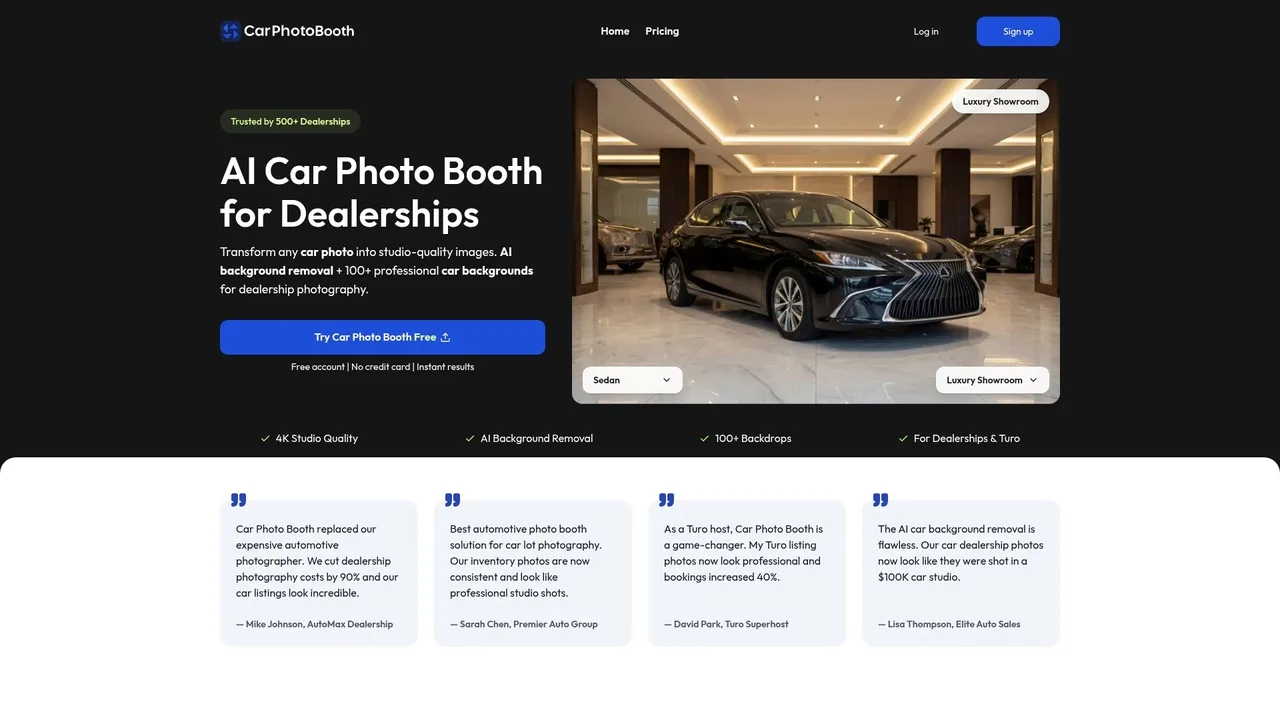
Car Photo Booth interface automating background removal and scene replacement for multiple car photos
### Quality & Brand Consistency at Scale
AI ensures every vehicle is presented under uniform lighting, angle, and background—critical for brand coherence across digital showrooms. A leading auto dealer noted: "Since switching to AI, our listing conversion rate increased by 30% due to uniform photo quality." This level of consistency is nearly impossible with manual editing, where subtle variations erode professionalism.
For scalable visual excellence, explore our guide to professional car backgrounds that enhance buyer engagement.
Key Features to Look for in 2026’s Car Photo Editing Tools
As AI reshapes automotive visual content, selecting the right editing tool requires more than basic functionality—it demands precision, consistency, and scalability tailored to vehicle imagery. For dealerships, Turo hosts, and auto photographers, these core features separate professional-grade tools from generic editors.
Automated Background Removal with Precision Masking
Accurate clipping is non-negotiable. Cars present complex contours—curved body panels, reflective glass, intricate grilles, and transparent windshields—that challenge even advanced AI models. The best tools leverage automotive-specific training data to generate pixel-perfect clipping paths, preserving fine details without manual correction. This eliminates reliance on traditional photo clipping path services, which introduce delays and inconsistency. At Car Photo Booth, our AI is trained exclusively on vehicle geometries, ensuring clean edges around mirrors, badges, and alloy wheels—critical for producing studio-quality assets at scale.
Studio Scene Replacement: From Garage to Showroom
A professional presentation extends beyond clean cutouts. Top-tier platforms offer diverse, high-resolution backdrops—urban streetscapes, minimalist studios, dealership showrooms, and scenic outdoor environments. More importantly, they simulate realistic reflections and perspective alignment, so the vehicle appears naturally integrated, not pasted. This level of realism enhances buyer trust and engagement, making it easier to showcase inventory in premium contexts without costly photoshoots. Explore our curated selection of professional car backgrounds to elevate your listings.
Lighting & Color Correction for True-to-Life Results
AI must balance exposure, contrast, and white balance to reflect the car’s actual appearance. Over-saturation or artificial HDR effects undermine credibility. Advanced retouch photo programs analyze lighting direction and surface reflectivity to harmonize the vehicle with its new environment, correcting lens glare and uneven shadows. The result is a natural, showroom-accurate image that supports informed buyer decisions.
Batch Processing for High-Volume Dealerships
Efficiency is paramount when managing large inventories. Look for tools that support bulk uploads, automated editing pipelines, and integration with inventory management systems. Batch processing transforms hundreds of photos simultaneously—ideal for daily lot rotations—without sacrificing quality. This capability turns what was once a multi-day retouching program into a minutes-long workflow.
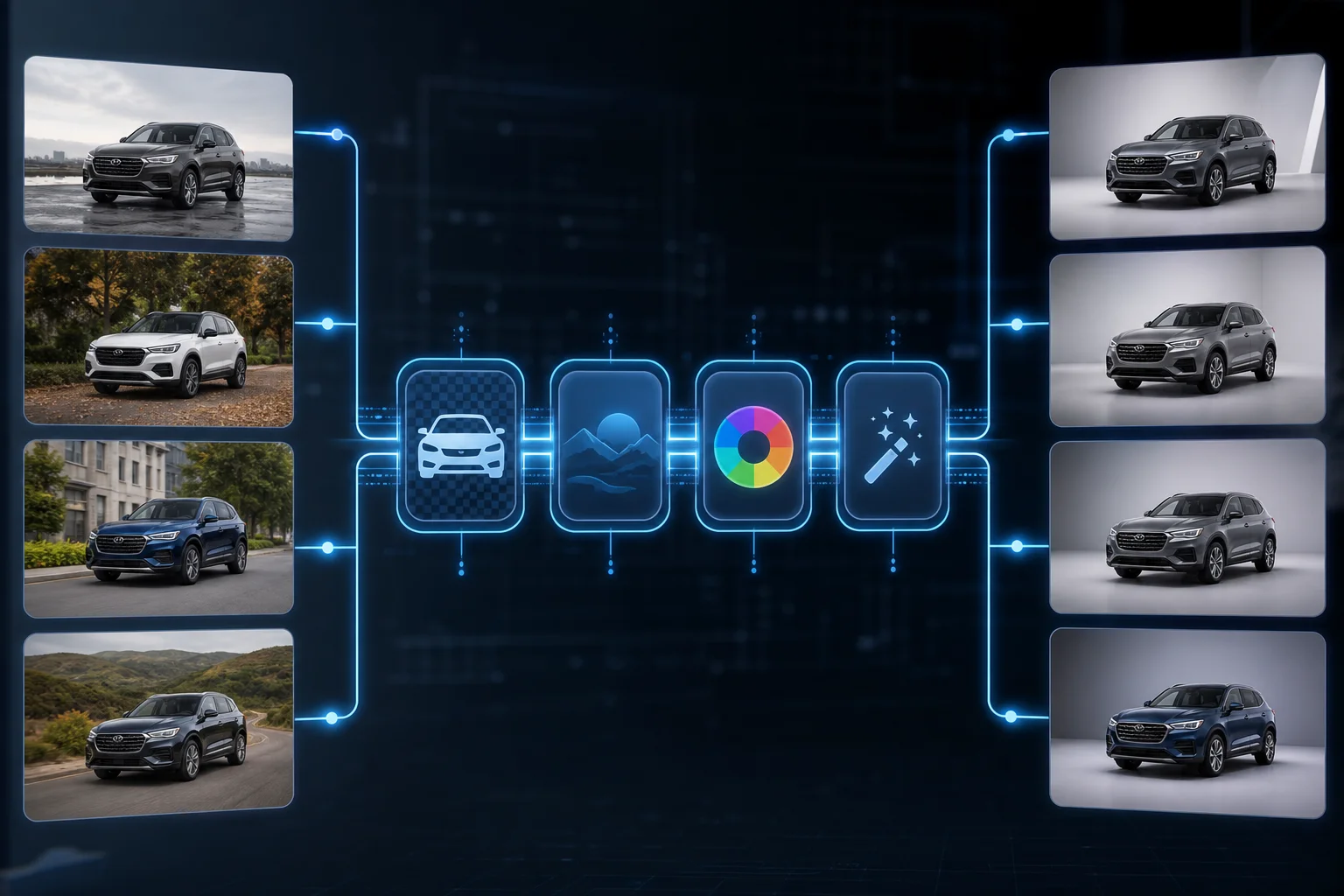
How AI transforms raw car photos into professional visuals through automated stages
How to Use Car Photo Booth to Edit Real Estate Photos (Yes, Cars Too)
While "real estate photo editing" often refers to property visuals, the same demand for polished, consistent imagery applies to car listings—where first impressions directly impact buyer engagement. At Car Photo Booth, we’ve engineered our platform specifically for automotive professionals who need studio-quality results without studio costs. Transforming a smartphone snapshot into a professionally edited picture takes just four streamlined steps.
Step 1: Upload Your Car Photo
Begin by capturing a well-lit, full-body shot of the vehicle on a neutral background—daylight or garage lighting works best. Avoid shadows and obstructions. Upload directly through our web interface or integrate via API for automated workflows. Whether you're managing a single Turo listing or an entire dealership inventory, our system is built for seamless ingestion of raw car photography, setting the stage for precision AI processing.
Step 2: AI Automatically Removes the Background
Our advanced AI detects the car’s contours with pixel-level accuracy, removing cluttered backgrounds and creating a clean mask in seconds. No manual clipping paths or layers required. This intelligent object removal ensures even complex edges—side mirrors, wheels, and grilles—are preserved naturally. It’s the same technology behind our guide on how to remove background from car photos, now fully automated.
Step 3: Choose a Professional Studio Scene
Select from over 100 high-resolution environments tailored to automotive branding. Options include 'Modern Showroom', 'City Night Drive', and 'Coastal Road'—each designed to complement your vehicle’s character. These professionally curated scenes align with proven visual strategies in ecommerce product photo editing, enhancing perceived value and trust.
Step 4: Download & Publish Instantly
Export your transformed image in JPG or PNG format at 4K resolution. Use transparent backgrounds for catalogs or composite designs. With one click, publish to inventory platforms, marketplaces, or social media—ensuring consistency across all your digital touchpoints with professional photoshop services delivered at scale.
When to Hire a Human Editor vs. Using AI in 2026
The rise of AI in automotive photography has redefined efficiency, but it hasn’t eliminated the need for skilled human editors entirely. The decision between automation and manual retouching now hinges on purpose, volume, and precision thresholds—not just cost. Understanding this balance ensures your visuals meet market demands without over-investing in unnecessary labor.
AI Wins For: Daily Listings, Turo Ads, Inventory Updates
For high-volume, time-sensitive tasks—such as updating online inventory, publishing Turo listings, or refreshing marketplace ads—AI delivers consistent, professional-grade results at scale. Tools like Car Photo Booth automate background removal, scene replacement, and resolution enhancement in seconds, eliminating the need for costly freelancer photo editing or traditional photo editing companies. This efficiency is critical for dealerships managing dozens of new arrivals weekly, where speed-to-market directly impacts conversion. These systems excel at producing uniform, clean images optimized for digital catalogs and SEO performance, aligning with strategies outlined in our guide to how to clean up pictures for car listings.
Human Editors Still Needed For: Brochures, Awards, High-End Auctions
When artistic nuance, brand storytelling, or editorial excellence are paramount—such as luxury vehicle brochures, award submissions, or high-end auction catalogs—human-led retouch photo programs remain unmatched. Complex composites, lighting refinements, or custom visual narratives often require the judgment and creativity that only experienced editors provide. While AI handles 95% of routine automotive imaging, these specialized use cases justify the investment in professional photo editing services where pixel-perfect control and aesthetic direction are non-negotiable.
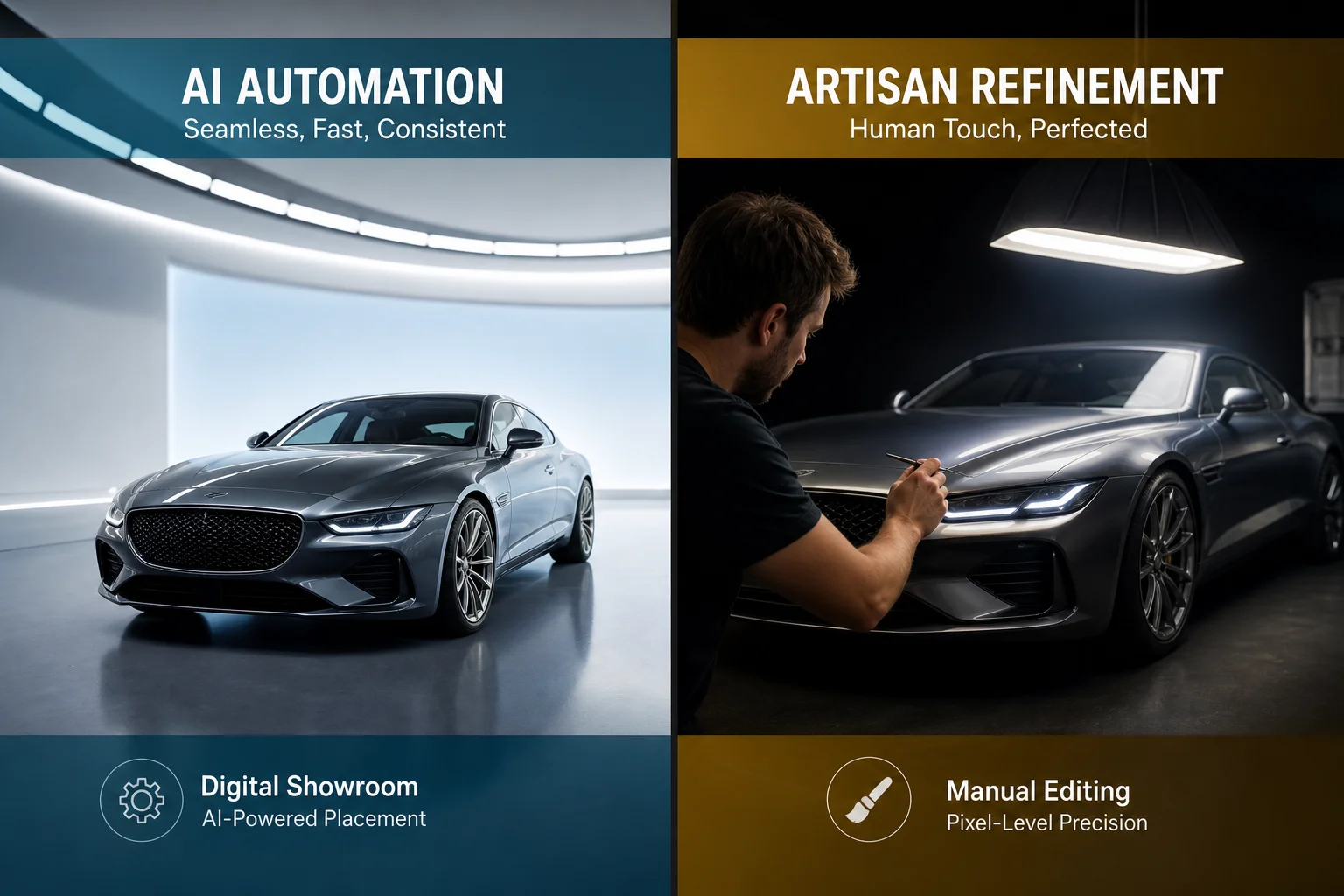
AI for speed and scale, humans for artistry and precision in car photo editing
Final Verdict: The Future of Car Photo Editing Is AI in 2026
By 2026, AI-powered editing has become the definitive standard for automotive visual content—delivering speed, consistency, and studio-quality results at a fraction of traditional costs. For dealerships, Turo hosts, and auto marketers, tools like Car Photo Booth eliminate reliance on expensive photo editing hire or outsourced professional photo editors, automating background replacement, glare correction, and image cleanup in seconds. What once required hours of manual work now takes place instantly, enabling teams to publish polished, SEO-optimized listings aligned with strategies from our guide to how to clean up pictures for car listings.
While professional photography retouching still holds value for luxury campaigns, AI now handles the vast majority of day-to-day imaging needs. Online photoshopping service platforms built specifically for vehicles offer unmatched scalability, ensuring every photo meets brand standards without human intervention. Traditional workflows can’t compete with this efficiency—nor with the cost savings of replacing per-image freelancer fees with a single subscription. The shift isn’t coming; it’s already here. For high-volume, digital-first automotive sales, AI isn’t just an option. It’s the operating system.